The Open Hood.

Understanding how AI works under the hood isn't about knowing more; it's about predicting where it's going. In my read, AI is strongest at code because code can be graded: it runs or it doesn't. It's only now arriving in writing, marketing and business. While it's still arriving you can see how it's wired, catch up fast with a lazy prompt, and become a builder rather than a buyer.
01The people who know how to run
Some people just seem to know how to run.
You've seen them. Same park, same Sunday, nothing special about the shoes, and yet they move differently. Lighter. Quieter. They come out of the bend at the same pace they went into it, and somehow they don't look like they're paying for it.
Talk to one of them and it's rarely raw talent. They know what's going on. Everyone knows the basics: move your legs, stay upright, breathe. The good runner knows why the back stays straight, and what a slump does to the breathing and the hips. They know why you land a certain way, what a heel strike sends up into your knees, and what a midfoot landing gives back to you as spring. They know where the energy comes from and where it leaks out.
You can copy what they look like. Straight back, short stride, light feet. You can buy their exact shoes. It won't turn you into them. Copying form is not the same as copying skill.
You don't have to become a sports scientist. You can just run, and you probably should work with a coach. But the people who are genuinely curious about how their body responds seem to keep finding another ten or twenty percent, long after everyone else has levelled off. It isn't that they train harder. They know which dial they're turning.
A house works the same way, only slower. Renovating one is dusty, over budget and mildly miserable, and it's also the one time the walls are open. You see where the pipes run, which wall carries the floor above, which wire goes where. So years later, when something leaks, you don't stand in the hallway reading a brochure. You know exactly who to call and what to tell them. Understanding the house is fun, though it's more than that. It stays useful for as long as you live there.
That brings me to the question under this whole piece. I keep asking it about AI, mostly of myself:
Do you just want to be an end user and a buyer of something? Or do you want to be a builder of something?
I'm asking now because the walls are open right now, and I don't think they'll stay that way.

02While the walls were open
I've been lucky enough to be around for a few of these shifts from one way of doing things to the next. I didn't invent any of them. I just happened to be standing there while the walls were open.
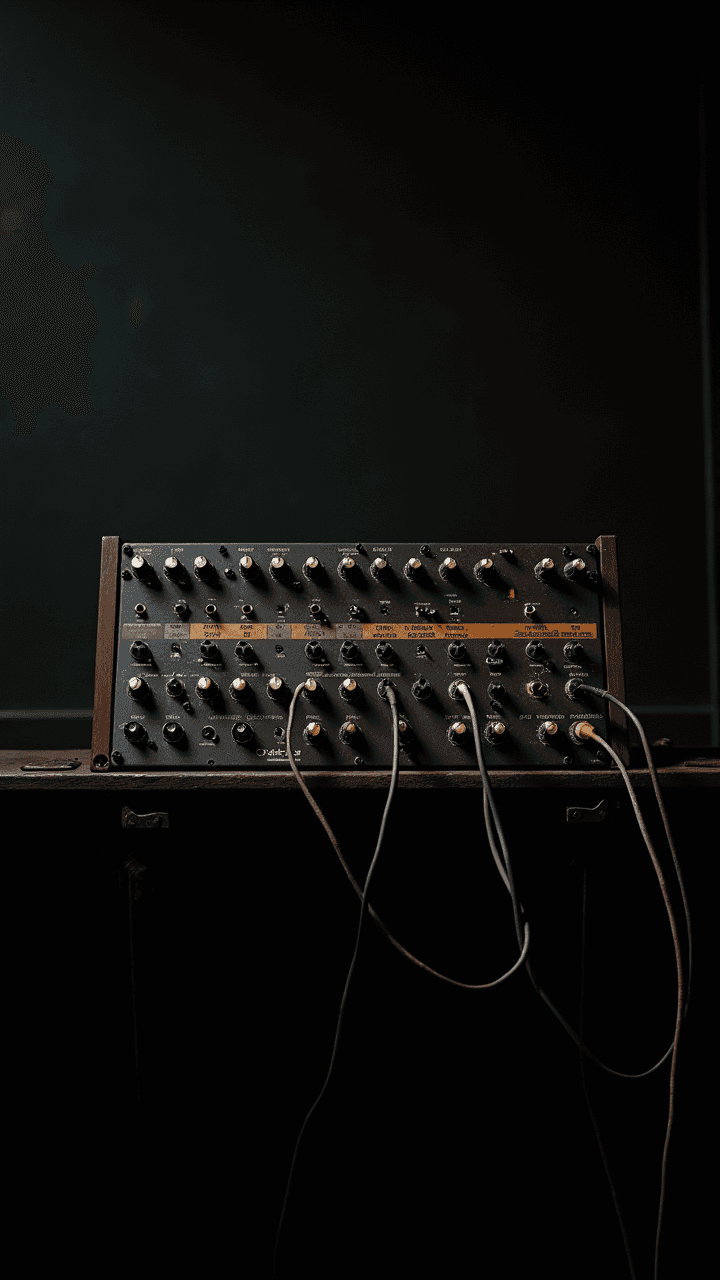
Music came first. I started out analog, with instruments, hardware and cables between boxes, and then the computer turned into the studio: softsynths, then the DAW. People talked about it as a whole new world. For me it wasn't one. If you know what a mixing desk does to a signal, what a compressor squeezes, and why a filter on a Moog sounds the way it does, a DAW is the old studio drawn on a screen. The signal path is the same. There are just fewer cables to trip over.
The internet went from a dial-up thing, with the screech and the phone line nobody else in the house could use, to something that's simply always there. If you understood it as messages travelling between machines, broadband wasn't a revolution. It was the same thing, except it didn't hang up.
Web analytics moved three times. First it was server-side: the server writing down every request it received. Then it was cookie-based: a small note your browser keeps and sends back. Then it was first-party: the question of who owns that note, and whose domain it lives on. Every move brought a wave of conference talks, white papers and vendor decks. I mostly needed a couple of lines: a server writes down requests, a browser keeps a note on behalf of a domain, and the open question is whose domain the note lives on. Everything else was detail. If analytics is a dashboard you buy, each shift feels like a new world. If you know the wiring, each one is a short list of consequences.
That isn't because I'm clever. I'm not the best in the room at any one of these things. I'd just built a foundation in how the internet was wired, so every new technology that sat on top of it was easy to read. I didn't need the folder, the brochure or the magazine about the thing I was trying to do. I already knew where the wires went.
That taught me something, and it's the point of this piece. Learning how something works under the hood isn't really about understanding it. It's about being able to predict where it's going, and adjusting how you respond before it gets there.
If you only know the outcome, you only know the symptoms. If you know how it works, you know what changes when something else changes.
The runner who understands foot strike feels the knee problem coming a few weeks before it arrives, and changes the stride. The homeowner who saw the pipes knows that new tiles in the bathroom mean checking the drain first. The marketer who understands how a model reads a brief can see why a vague one comes back beige, and fixes the brief before the third rewrite while others are still switching tools. In sport, in learning and in business, the edge is the same: you see the second-order effect while everyone else is still looking at the first one.
AI is the biggest version of this I've seen. And for once the timing is on our side, because it hasn't finished arriving.
03How it's wired, as I read it
What follows is my read. I've spent a lot of evenings with this, but I'm not an AI researcher, so take it as “this is what I've seen”, not settled science.
Why it's best at what its makers know
Most of today's AI was built by engineers and scientists. Making it is a scientific process and a creative one, and the people doing it have steered it toward what they decided to build, study and research. It's no surprise that it's best at the things closest to the people who made it.
There's a technical reason too, and I find it the more interesting one. A big part of how these models get better is reinforcement learning: the model tries something, the attempt gets graded, and the grade shapes the next attempt. For that to work, you need to be able to grade what the model did, cheaply and at enormous volume.
Code is gradeable. It runs or it doesn't. The test passes or it fails. You can check a million attempts without a single human in the loop. Now try grading a brand line. Ask three CMOs and you'll get four answers, and a fifth one the following Tuesday.
So the thing AI is really, really good at right now is coding. I don't think code is easier than marketing. I think code tells you when you're wrong.
It's now walking into your world
AI is now working hard at everything else: writing, marketing, business. It's not mature there yet. There are real use cases, and I use several of them every week. But the real gut of it, the stuff that makes you sit back in your chair, is still happening in the coding space.
That gap is the invitation. While AI is half through the door of your field, you can still see three things that will be much harder to see once it has fully arrived:
- Why it responds the way it does. When it gives you a beige answer, that isn't random. It's often the average of every similar answer it has seen, because nothing in your brief told it to aim anywhere else. Once you notice when it falls back on the average, you've learned what it's actually doing.
- What it gets right and what it gets wrong. Its mistakes follow a pattern, and the pattern is a map. Where does it flatten a nuance in your category with total confidence? Where is it surprisingly sharp? Today you can still watch that in the open. Once it's polished and packaged into a product, the seams get sanded away.
- What scaffolding it needs. In coding with AI, the everyday words are scaffolding and harness: the instructions, tools, checks and memory you build around a model so it does reliable work instead of impressive one-offs. This is where it gets interesting for the rest of us. A harness is how you make an ungradeable field gradeable. Marketing doesn't grade itself, so you write the rubric. You define what good looks like, give the model the checks, and let it test itself against them before it hands anything back.
I think harnesses might become one of the most important things out there, and understanding the concept gives you an edge right now. I've written about it separately in The Agentic Nephew. The short version is that most of the difference between a toy and a colleague is the harness, not the model.
So here's the line I'd underline: the hood is open precisely because AI hasn't finished walking into your field yet. Once it has, you'll get the brochure like everyone else.
Why you can still catch up
At this point some readers start to feel late. Let me take that feeling apart, because I think it's mostly wrong.
In my day job, people join the team, people leave, people go on parental leave, and everyone takes breaks. In the evenings I build things myself, mostly vibe-coded, with the AI doing the heavy lifting. I'm not an engineer. Even so, I've watched people who joined the team late catch up, and quickly.
My own route started about two summers ago, in three stages, and each one took real time to learn, grasp and structure:
- Prompting. I learned to write a good prompt, and back then a good prompt was a detailed one. It meant paragraphs of role, context, format and constraints, rewritten until the output stopped drifting.
- Skills. I set up a harness and spent evening after evening writing skills: small, reusable written instructions the model could pick up when it needed them. (What that turned into, boiled down to a list, a manual and a clock, is in The Only-Me List.)
- Manual orchestration. I learned to split a job into parts, sequence them, decide which instance did what, and give the whole thing structure by hand.
Today a frontier model with its slow, careful reasoning mode switched on will do a large part of that for you, as long as you don't fence it in too much. I call it lazy prompting: you write a high-level prompt that says what you want, without steering how it gets done. The model will take the time to spin up sub-agents to research the question. The coding harnesses now ship with a decent set of basic skills already wired in, so it doesn't have to reinvent what it does.
Two summers of my evenings, compressed into a default setting. I find that mildly humbling, and very good news for anyone starting now. The models have become the great equaliser.
So what do the concepts still buy you? They make you a somewhat better user. There's still a light user and a power user, and the difference shows up in four places:
- Pointing. A lazy prompt might work out by itself which skills it needs, try a few that don't fit, and get there in a couple of days. A power user points it at the right skills straight away.
- A shelf. A power user keeps a steady repository of skills that are tested, named and ready to use.
- A workshop. A power user runs an isolated workspace that gathers learnings across everything they do and turns repeated lessons into new skills.
- A spanner. A power user can update and change their own system without asking the frontier model to do it, which means fewer tokens and quicker work.
None of that is required. You don't need to know all these core concepts to be great with AI and have real impact. The light user with a good lazy prompt is already doing better work than most people were doing two summers ago with a page-long one.
And the bar keeps moving in your favour. My guess is that by the next frontier generation, three or six months out, even those power-user moves (isolation, learning across data, building skills, token efficiency) will mostly happen inside a conversation after a lazy prompt. The model will build its own shelf.
Two honest caveats
First, I could be wrong about how long the window stays open. The labs are working hard on grading the fuzzy stuff: rubrics, models that grade other models, human preferences collected at scale. If they crack it for writing and strategy, AI could walk into your field faster than I expect. To me that's a reason to start sooner, not to wait and see.
Second, catching up and understanding are not the same thing. The model will happily carry you through the door. It won't tell you why the door was where it was. That part you still have to want.
The two halves of this section sound like they contradict each other, but they don't. You can catch up, and understanding still matters. Shoes and a coach will get you round the park. Knowing why the back stays straight is what gets you the extra ten or twenty percent, and tells you when the knee is about to complain.

04The hood is open now
To pull the threads together:
- The model will carry you through the door. You can catch up.
- Understanding the gears means you walk through it faster and sharper, and you see what's coming next.
- The hood is open now, while AI is still arriving in business. That's the window, and it's a window, not a wall.
So start, and start small. Pick one thing you do every single week, like the status update, the campaign recap or the first draft of a brief. Give it to a frontier model with a lazy prompt, and then do the part most people skip: ask it to show you the wiring.
Here's a task I do every week: [describe it in two or three sentences]. Do it the way you think is best. Then tell me: what did you assume about my situation, where were you guessing, and what would you need from me to do this reliably every week?
That last question is the hood opening. The assumptions show you why it responds the way it does. The guesses show you what it gets wrong. And the list of what it would need from you is your first piece of scaffolding. Write it down, keep it, and paste it in next week. That's a skill. It's small, but you built it. (If you want the human version of the same discipline, saying exactly what good looks like, it's in Agent Inclusive.)
I'm not against buying. I buy most things, and so do you. But listen to the two kinds of question. The buyer asks: which tool should I get? The builder asks: how is it wired, and what would I change? The first gets you a subscription. The second gets you a forecast.
If you'd rather touch the idea than read about it, the little tool below lets you name something you use at work and shows you roughly how AI is wired into it, plus one experiment to try this week. Five minutes of clicking is worth thirty of explaining.
Pick something you use at work, or type your own. You get back how it's wired, where it sits on the gradient, and one experiment for this week. Nothing is sent anywhere.
Pick a task above to open the hood.
Illustrative, not measured. Static text, no AI calls.
And if you run the experiment, tell me what the model assumed about your job. Drop me a line. I won't pitch you anything. I'm collecting the wrong guesses, because they're the most honest map I know of where this is going.
Next in the arc: what a harness actually is, and why your twenty-year-old nephew needs one, in The Agentic Nephew.