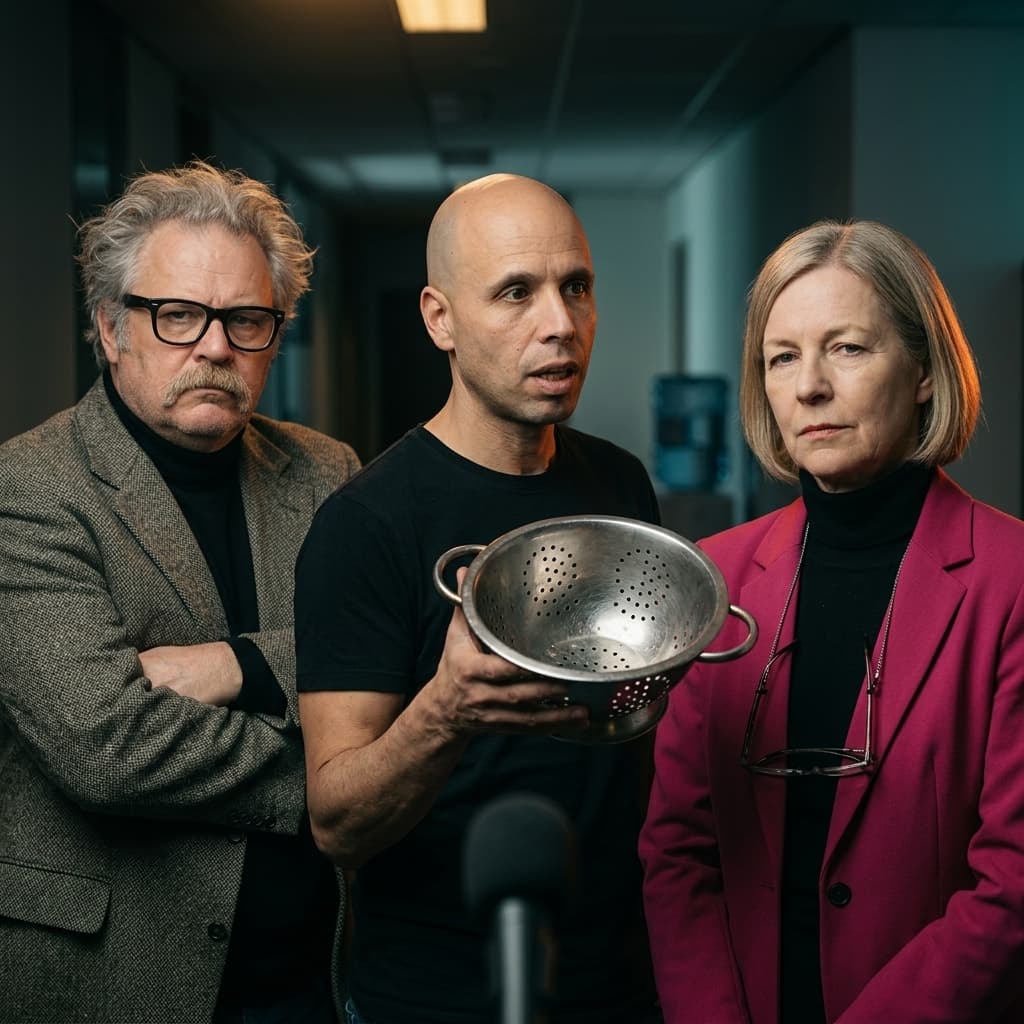
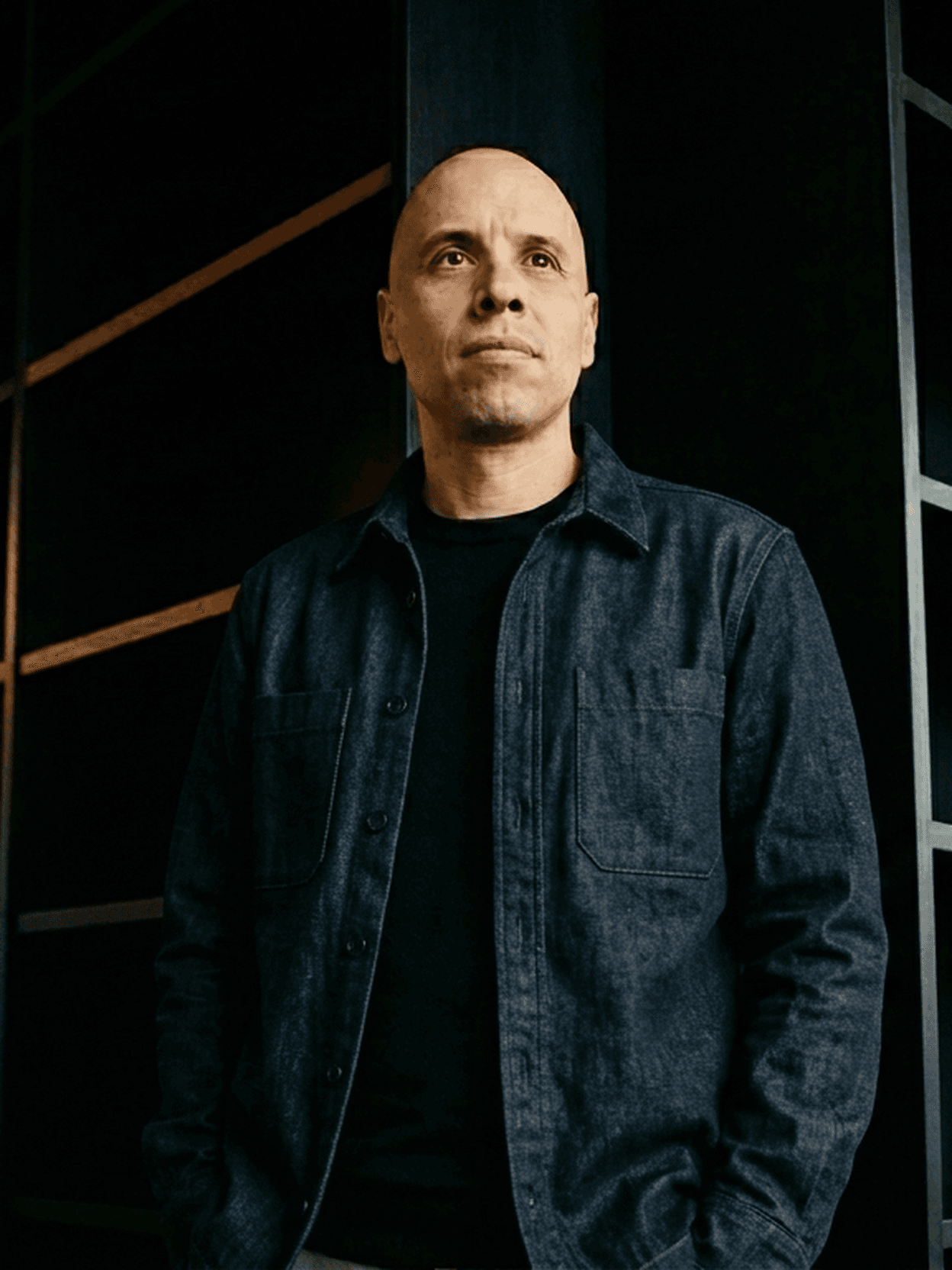
 Rutger
 Angela
 Dino
Dino
00:00 / 10:50
Op deze site: The Colander.
TRANSCRIPT
- Rutger
- Welcome back to The Seam. I'm Rutger — and today's episode comes with a kitchen utensil, a new job, and the oldest lesson I know.
- Angela
- Angela. I've allotted this forty minutes. It will take thirty if everyone behaves.
- Rutger
- [laughs] And the man who has never once behaved — Dino.
- Dino
- [grunt] I read the piece. I agreed with the colander. Write the date down.
- Angela
- Noted. First agreement of the fiscal year.
- Rutger
- Let me set it up. When I was about twenty, someone told me one thing I never let go of: you can hold me accountable for the *what* — but then I determine the *how*. And the picture I use for what organizations do instead: suppose I pay you per liter of water you carry from A to B. You're already thinking about buckets. And then I say — actually, you'll carry it in a colander. Walking backwards. Doing somersaults.
- Dino
- And then they ask why the floor is wet.
- Rutger
- And then they ask why the floor is wet. There's a little game on the article page where you can feel this happen — you tap, you carry, you're brilliant at it, and then the memos start arriving.
- Angela
- I played it. During a call, I should say.
- Rutger
- [laughs] And?
- Angela
- I passed all my performance reviews. Apparently that's rare.
- Rutger
- How?
- Angela
- I read the directives before adopting them. Nobody reads the directives, Rutger. That's how they pass.
- Dino
- I declined every memo. It came back. "Second reminder." I declined again. It said "mandatory." I closed the laptop.
- Rutger
- [laughs] That's — honestly, that's a legitimate ending. That's the fourth ending. I should count it.
- Dino
- It's the only ending. Everything else is negotiating with a colander.
- Rutger
- But here's the serious spine of it. As you get more senior, you really are held accountable for the what. It's in your grading, your rewards — the existence of your job is a deliverable someone needs. But if the how quietly becomes the expectation, the organization can't honestly hold you accountable for anything anymore.
- Angela
- Mm.
- Rutger
- You've seen this. Forty years of operations.
- Angela
- I have *implemented* this. That's worse. Somebody two floors up invents a how — a template, a cadence, a new form — and the person who walks it into the room is me. I have carried other people's colanders for forty years. You learn to hold them at a slight angle. Less spills.
- Rutger
- [quiet] That's the most operations sentence ever spoken.
- Angela
- It's on my performance review.
- Dino
- My method is cheaper. "No." It's a complete sentence. I've built an entire career on it. The trick is you have to deliver the what so well they stop asking about the how. Nobody audits the kitchen of a restaurant with three stars.
- Rutger
- That's exactly the deal, though — that's the whole doctrine in one line. The what buys the how. And there are legitimate hows! If the job is sales, seeing customers isn't a colander. Quality bars aren't a colander. The line is where the how gets so restrictive — and honestly so arbitrary — that the what can't be delivered anymore.
- Dino
- The line is somersaults, Rutger. The line is always somersaults.
- Rutger
- So — new job this year. Old one ceased to exist, clean break, and the interview process does something to you: you build resolve. This time I start differently. Three moves. One: don't import an operating system — borrow one the organization already trusts. I looked at our research lab for the long-term thinking, at product for shipping cadence, and it turned out the method I knew from earlier companies snapped onto the quarters we already run.
- Angela
- This is the first playbook you've described that doesn't require me to buy anything. Continue.
- Rutger
- [laughs] Two: introduce behaviors that ride momentum the company already wants. We renamed standups to daily huddles — words the organization already loved — and within two months other teams were asking why they weren't doing huddles.
- Angela
- I can confirm. Two of them asked me. I told them to bring it up in their own meeting. It's called boundaries.
- Rutger
- And three — the one I actually want your read on, Angela. Wire AI into the cumbersome work. The rhythms fail because running them well eats time nobody has. So: an orchestration layer that watches the steady documents and nudges when we drift. One-on-ones prepared from the whole file — history, feedback, development plan — instead of covering "the now" for the eleventh time. And a weekly report to my manager that writes itself against what's actually expected of me.
- Angela
- ...Mm.
- Rutger
- That was a different "mm."
- Angela
- You built a me.
- Rutger
- [beat] I built the part of you that files. Nobody has built the part that raises one eyebrow and a third revision withdraws itself. I don't think anybody can.
- Angela
- [small pause] Correct. Continue.
- Dino
- [to Angela] Take the compliment. It took him three moves and a research lab to reinvent a quarter of your job.
- Angela
- The filing quarter. He's welcome to it. I never liked the filing.
- Rutger
- Hold on — I want to sit on that for one second, because it's the honest version of the whole AI conversation. The cumbersome quarter of the job is buildable. The judgment quarter isn't. If the machine takes the filing and leaves the eyebrow, everyone gets a better week. That's the trade. Okay — speaking of people selling frameworks: a word from someone who couldn't be here, and honestly, that's for the best.
- Rutger
- [coming back] The Governance Immersion.
- Angela
- He sent me the brochure. I filed it.
- Dino
- Under?
- Angela
- No.
- Rutger
- [laughs] Perfect. No notes.
- Rutger
- One more thing from the game, because people keep mentioning it. The performance reviews. The target comes from your own best clean rate — and when you pass, the target goes *up*. While the memos keep arriving.
- Angela
- That's not satire, that's the template. I've formatted that template.
- Dino
- They put me on an improvement plan once. Nineteen eighty-nine. Client wanted the logo bigger and the campaign faster and also cheaper. I missed the deadline twice, so they gave me a plan.
- Rutger
- What happened?
- Dino
- I improved the plan. Took out the somersaults. Delivered the campaign. It ran nine years.
- Rutger
- [laughs] "I improved the plan" — that's the conversation! That's literally the mechanic: either the how becomes the what and we agree on it as such, or I deliver the what and I determine the how. Dino did it with a red pen in 1989.
- Dino
- A red pen and a door that locks.
- Rutger
- Let me do the honest part. The loop doesn't make the judgment calls — the Tuesday-at-four conversation with a skeptical CFO is still mine. The eyebrow is still Angela's. And the three moves only work in that order: what first, protected how, then the machines on the cumbersome part. If you start with the machines you've just bought a very fast colander.
- Angela
- Which brings us to point seven on my agenda: the disclaimer. [reading, flat] None of this represents his employer. Personal views, personal site, personal time. The voices are synthetic; his is a clone of his own, which I have chosen not to think about. Dino and I are fictional. The colander, regrettably, is real.
- Dino
- [grunt] The colander is always real.
- Rutger
- [laughs] Last words — Dino first.
- Dino
- Deliver the what. Guard the how. And when they hand you a colander — hand it back. Politely, the first time.
- Angela
- Decide the what, write it down, and stop inventing hows for people who were already carrying the water. Also: read the directives. Meeting closed — four minutes early.
- Rutger
- [warm] Write down the what. Own your how. And if you take one thing from tonight: the moment you get a clean break is the moment you get to do it differently. This time, do it differently. Goodnight.