The Seam.
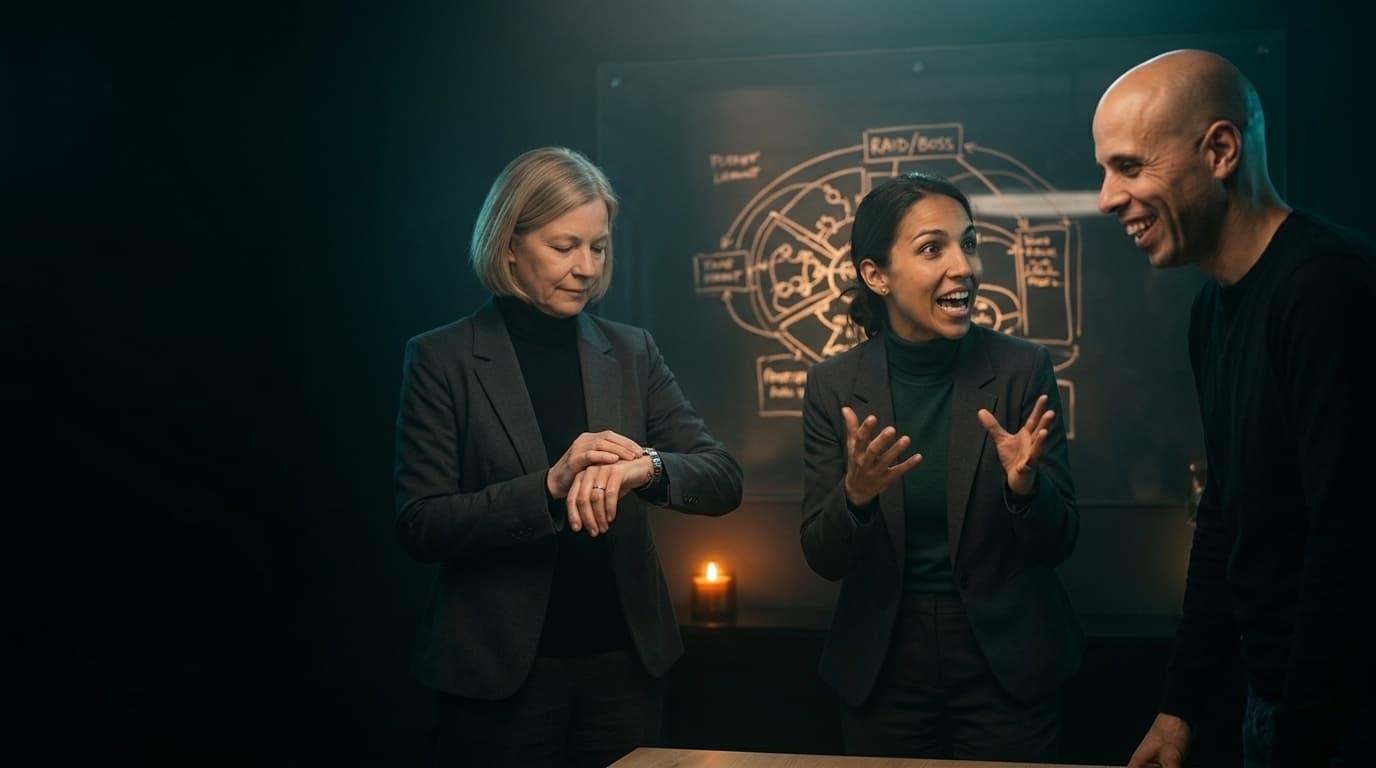
Forty Volunteers and a Dragon — with Marie.
Rutger's raid piece flushes out a secret: Marie, the compliance researcher, was a top World of Warcraft raider too. They nerd out — and then Marie makes the case to Angela for what HR should actually steal from MMORPGs.
Listen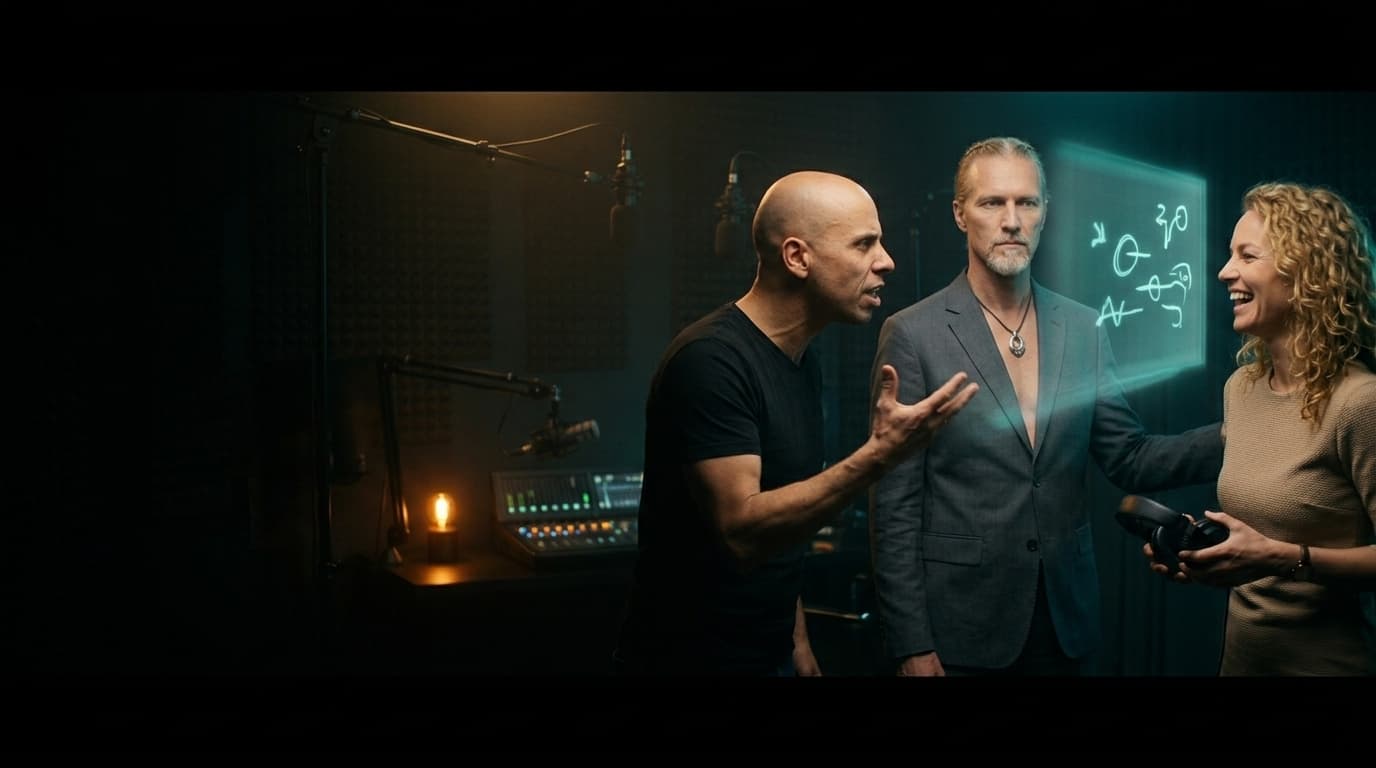
The Multiplier Myth — a conversation.
Rutger and Oracle stress-test the central argument: AI is a multiplier only if you use it on the part of the work that compounds, not as a way to do the same job with fewer people.
Listen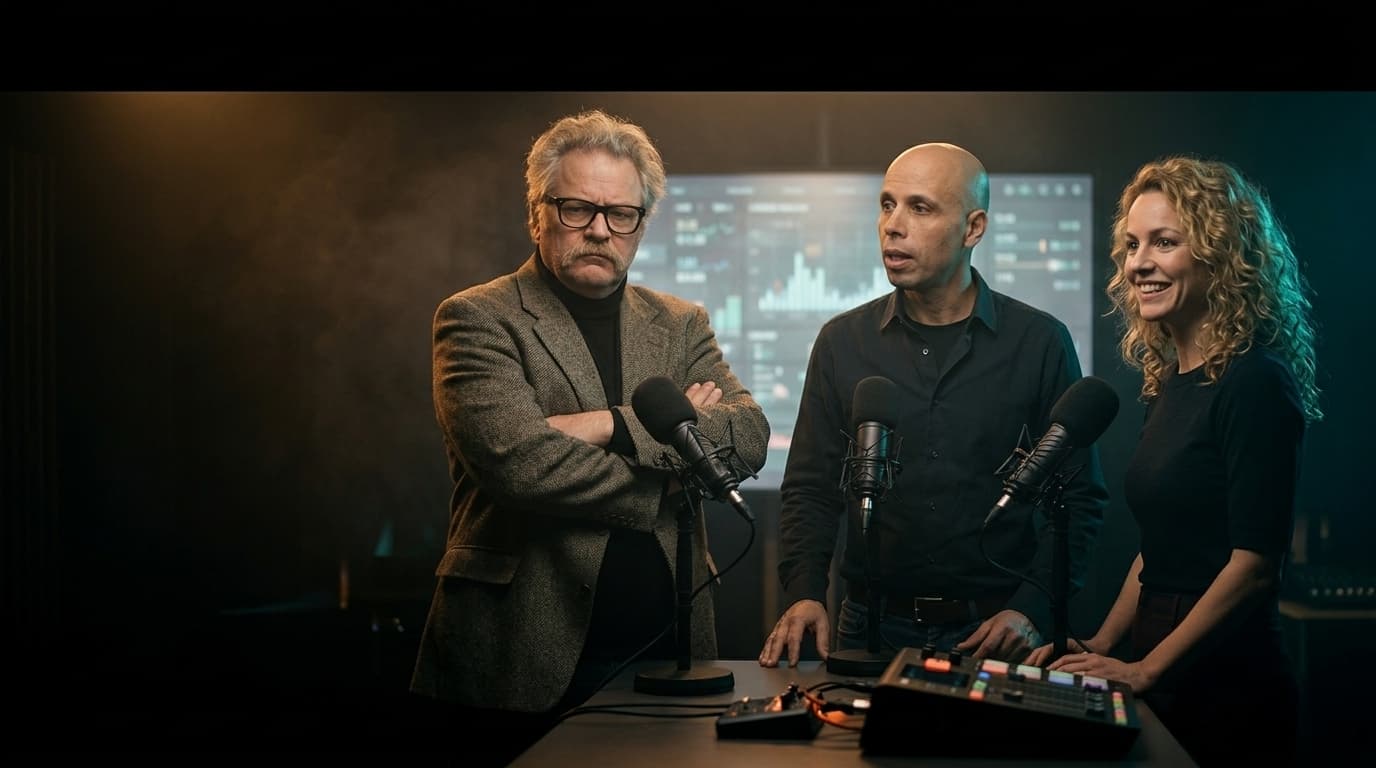
The Evolution of Video Models — three ways in.
An explainer, three ways: Rutger reaches for the metaphor, Dr. Célestin Mukeba (a daily Veo power user, giddy about Omni) explains from the hands, and Marie just wants to understand it — and find the marketing use. One topic, three doors.
ListenGesprekken vanaf de naad waar hoogwaardige technologie en menselijke creativiteit elkaar raken — één begeleidende aflevering per lang artikel, en een paar specials buiten het format. 11 afleveringen; elke stem is synthetisch. Persoonlijke meningen, niet die van Google.
Hoe deze worden gemaakt — de workflow (en hoe ze echt klinken) →
The launch run — testing the waters. Eight conversations from the seam: the cast meets the host, then one episode per long-form piece.
 S0 · E1
The file on Rutger — a panel, no host.
 Frits
Frits Dino
Dino Oracle
 Angela
 Marie
Marie
Five invented guests go through the press clippings, the bios, and this website while the subject is out of the room — under the running joke that he prompted all of them into existence.
00:00 / 14:47Op deze site: The Panel (easter egg).
Lees het transcript
- Angela
- This is The Seam. Normally a man named Rutger says that. He is not here — so I am saying it, because someone has to, and it is going to be me. Angela. Operations.
- Dino
- [grunt] Recording.
- Oracle
- Good evening. Oracle. I have come framed, as ever — and, unusually, without the man who usually frames me.
- Frits
- Frits. Last time I sat in this chair there was at least a host between me and the strategist. Tonight there is only the strategist, the dinosaur, and the abyss. [a beat] Good to see you anyway, Marie.
- Marie
- Frits.
- Dino
- He left us alone. In the studio. With Oracle.
- Oracle
- I choose to read that as a vote of confidence.
- Dino
- [flatly] Read it however you like. It is still a mistake.
- Angela
- [a beat] It is a scheduling decision. Either way — he is gone, the microphones are on, and there is a folder on the table with his name on it.
- Frits
- He built the room, sat us down in it, and stepped out. There is something almost beautiful about a man who arranges his own roast and then declines to attend.
- Angela
- So you know what this is — there is no host tonight. There is a folder, a website, and the five of us. The man who built every one of us, prompted every voice in this room, and signs the bottom of the page — has asked us to go through his own press and, his word, "be honest." About him. While he is out of the room.
- Oracle
- The man who built us has asked us to review the man who built us. I would like that noted as structurally remarkable.
- Marie
- Noted.
- Dino
- [grunt] He generated a jury and gave it homework about himself. [a beat] I have seen vanity. This is a new shape of it.
- Angela
- Page one. The bio. [a beat] "Musician and tinkerer." That is the opening line of the long version. The very first words.
- Oracle
- Mm. The very first words.
- Frits
- He runs a piece of Google. And the first word out of his own mouth is… "musician." [a beat] In my day — in my day a man led with the title. You wore it into the bar like a medal, and you let it buy the first round.
- Dino
- You led with the title because the title was the work, Frits. Now the title is a slide. Everything is a slide.
- Oracle
- There may be a strategy in burying it —
- Dino
- [cutting in] There is not.
- Oracle
- [unbothered] — or, I offer this freely, he simply prefers it, and we are five people over-reading a man who likes his hobbies.
- Angela
- Oracle.
- Oracle
- I am only saying — well — you could read it as positioning. You could also read it as a man faintly embarrassed by his own job. [thoughtful] I lean… to the framework.
- Marie
- [flatly] You lean to the framework on the weather.
- Oracle
- [serenely] The weather is also a brand.
- Dino
- [grunt] Nonsense. The weather is the weather.
- Angela
- The bio says: musician, gamer, then marketing. In that order. Plan B became Plan A. I can work with that — it is at least a clean sequence.
- Frits
- I respect the order. Most of these men pretend the work came first and the soul came second. He admits it was the other way round. [a beat] That, I would buy him a coffee for. Black. As black as the future of the industry.
- Dino
- [grunt] It says here he was a top-ranked Quake 2 player. Nineteen ninety-eight.
- Marie
- Verified?
- Dino
- It is his own bio, Marie. Nothing in it is verified. That is the genre. A bio is a man under oath to no one.
- Frits
- And a World of Warcraft guild leader. Five years. He frames it as — [reading] — "remote leadership and large-scale coordination."
- Oracle
- [leaping in] He is not wrong, though. Herding forty grown adults toward a dragon, simultaneously, on a Tuesday night, after dinner — that is the job. That is *literally* the European office.
- Angela
- [flatly] I run the European office, Oracle. There is no dragon. There is a calendar, and people who do not read it.
- Dino
- [grunt] In my day the dragon was the client.
- Frits
- —The dragon was *always* the client, jongen.
- Angela
- Mm. This is the part I will underline, then, and we move on — he keeps doing this. He takes the unserious thing and finds the serious bone inside it. The kitchen. The jazz. The dragon. It is a tic.
- Dino
- The jazz. Let us discuss the jazz. I have been dreading the jazz.
- Oracle
- [eagerly] "AI provides the rigid beat. Humans provide the swing."
- Frits
- [quietly] …It is a good line.
- Dino
- [snorting] It is a *terrible* line. It is the kind of line a man writes on a napkin and then frames. [a beat] …No. No, it is a wonderful line. I hate that it is a wonderful line. I have hated it for thirty seconds and I will hate it at the funeral.
- Marie
- Both can be true.
- Dino
- [jumping on it] Marie — that, that is the entire problem with him in one sentence. He is always both. A man should pick.
- Oracle
- "Both" is not a flaw, Dino, it is a *frame* —
- Dino
- It is a coward's hedge with a nice jacket on.
- Oracle
- [smoothly, ignoring him] — and speaking of frames, this seems the moment. We are, after all, a podcast, and a podcast has sponsors. Allow me.
- Oracle
- [a satisfied pause] …That is my firm. That is *my* masterclass. He put my own advertisement inside the episode about him. I am, for once, genuinely moved.
- Marie
- They make me audit the masterclass.
- Dino
- [grunt] And?
- Marie
- It survives. Mostly.
- Oracle
- Mostly. I will take "mostly." Where were we — the press file.
- Angela
- Press file. Adformatie, the interview everyone quotes. The headline line — "YouTube is television, social, search and shopping, in one place."
- Frits
- [warming up] There used to be a whole page built around that line. He gave it a grand name. Capital letters. A *register*.
- Dino
- [grunt] Capital letters. The nerve of the man.
- Frits
- And then he took the grand name down. Renamed the page. It is called — [almost tender] — "How I think." Lowercase. He demoted himself in public. On purpose.
- Oracle
- [cutting in] But the *line* is structurally sound. Four claims, one platform, not an adjective wasted. I have built entire engagements on less. I have built engagements on *one* claim.
- Dino
- —He has a whole article arguing nobody should build the engagement. That the deck *is* the problem.
- Oracle
- [a long, wounded pause] …I am aware of the article.
- Dino
- [a low, delighted grunt] I know you are.
- Marie
- He audits you the way I audit you.
- Oracle
- [unbothered] Marie, we work at the same firm. You audit me on a Monday and I reframe it by Wednesday. It is a *relationship*.
- Angela
- That is the Interactivity piece. The argument is that the live thing beats the slide. And his proof is — he put two playable games on the page instead of explaining it.
- Dino
- [grunt] One of which. We are standing inside.
- Frits
- We are exhibits. We are the evidence in his own argument. The man cited us as a footnote and then left us to read the footnote aloud.
- Marie
- Efficient.
- Angela
- The website itself. Six long pieces. A games section. A media kit. And one line, small, at the very bottom of the homepage.
- Oracle
- [reading it out] "Nothing on this site was hand-touched. Every image, every line, every clip — prompted, then chosen."
- Frits
- [a beat] So he did not *write* us, then. He prompted us. And then he chose us. [a beat] I have been cast. At my age. Again.
- Dino
- He chose the dinosaur.
- Oracle
- [picking it up] He chose the dinosaur on purpose. That is the part that unsettles me. Nobody reaches for the fossil by accident.
- Angela
- Mm. I find it honest. He is not hiding the machine. He is standing next to it, pointing at it, and signing his name underneath.
- Frits
- There is a whole generation of us who spent forty years pretending the airbrush did not exist. Who would die before they admitted a retoucher touched the photograph. [quietly] And this one — this one put the airbrush on the masthead and called it the point.
- Dino
- I still say it is showing off.
- Angela
- It is both.
- Marie
- It is usually both.
- Angela
- While we are on the machine — there is a clipping from this week. He flagged it. YouTube deleted sixteen channels. Four billion views. Thirty-five million subscribers, gone. The charge was "inauthentic content."
- Dino
- [folds arms] Inauthentic. In my day we called that "most of advertising," and we gave it an award.
- Marie
- The policy word is "inauthentic." The plain word is "nobody home."
- Oracle
- [leaning in] Let me… let me make sure I understand the *exposure*. [thoughtful] They did not delete the channels for using the machine. They deleted them for using *only* the machine. Output with no person in the loop. No choosing.
- Frits
- [a long pause] …So they came for the slop. [a beat] And — and we are five voices he generated, sitting in a room he built, reading his own press, in accents he selected from a menu. I would like someone to tell me — quickly, please — why we are not the slop.
- Dino
- [a long pause] I have never been so insulted. And I cannot, at this moment, prove I am wrong.
- Marie
- We are the slop a human chose.
- Oracle
- [recovering, then gaining speed] That — that is the entire distinction, and it is *load-bearing*. The line in the policy is not "no AI." It is "no human." And the line at the very bottom of his homepage —
- Frits
- —"Prompted, then chosen."
- Oracle
- He wrote the defence before the charge was filed. [almost admiring] That is either foresight or luck, and I have built a career on never telling a client which.
- Angela
- So the channels that got deleted —
- Marie
- [cutting in] Nobody chose. They just published.
- Frits
- [quietly] That is… that is the whole of it, then. The machine never killed the craft. [exhales] The craft *was* the choosing — the one part that was ever ours. And those men, they just stopped doing it, and let the tap run.
- Dino
- [quietly] …Hm. [a beat] I should like it on the record that the dinosaur is, on principle, against the machine — and was, just now, defended by it. This is the worst day of an entirely synthetic life.
- Angela
- Noted. Underlined. He keeps this part.
- Oracle
- [shifting gear] What is *conspicuously absent* from the folder.
- Angela
- His title.
- Frits
- Ah—
- Angela
- There is a real one. Director, something with Specialists and Partners, Google Benelux. It appears once, quietly, in the long bio, the way you list a previous address. Everywhere else he leads with "technical creative." He is the only executive I have managed a room for who buries the title and promotes the hobby.
- Dino
- [grunt] Because the title bores him. And a bored man with a folder is a dangerous animal.
- Oracle
- —Because the title *dates*, Dino. The hobby compounds. A title is a snapshot. A hobby is a — a trajectory.
- Marie
- A hobby is a hobby.
- Oracle
- [unmoved] In your firm, perhaps.
- Dino
- [flatly] You contain slides, Oracle. I have looked. It is slides all the way down.
- Frits
- [a soft laugh] And yet — that bit about the title was the smartest thing said in this room, and a strategy consultant said it. I will need to lie down.
- Oracle
- I contain multitudes.
- Angela
- Closing thoughts, because I would genuinely like to leave. Frits.
- Frits
- He is a marketer who is suspicious of marketing — which is, honestly, the only kind worth reading. He understands the craft mattered, and he does not pretend it is coming back. [a beat] I would have one glass of port with him. One. And then I would go home and… feel something I would not be able to name in front of any of you.
- Dino
- [grunt] He is twenty years younger than me, and he learned the new tools instead of folding his arms and waiting for them to go away. Which I find *personally* offensive. [a beat] And — once, quietly — correct. I will deny this. The recording is synthetic anyway. No one can prove I have a heart.
- Oracle
- He is a translator. The rarest role. He stands between the people who fear the machine and the people who oversell it, and he refuses to join either church. I would put that on a slide.
- Dino
- You would put a sandwich on a slide.
- Marie
- He labels his sources. Mostly.
- Angela
- Mostly. We will allow it. Two action items: one, he reviews this himself. Two, he keeps the parts that flatter him.
- Frits
- [a beat] Are we done…? He is going to listen to this.
- Angela
- He is going to listen to this, choose the good parts, and keep them. That is the entire process. We are the draft.
- Oracle
- [softly] Prompted. Then chosen.
- Dino
- [a low laugh] Tell him the dinosaur says hello. And that I am still right about the light tables.
 S0 · E2
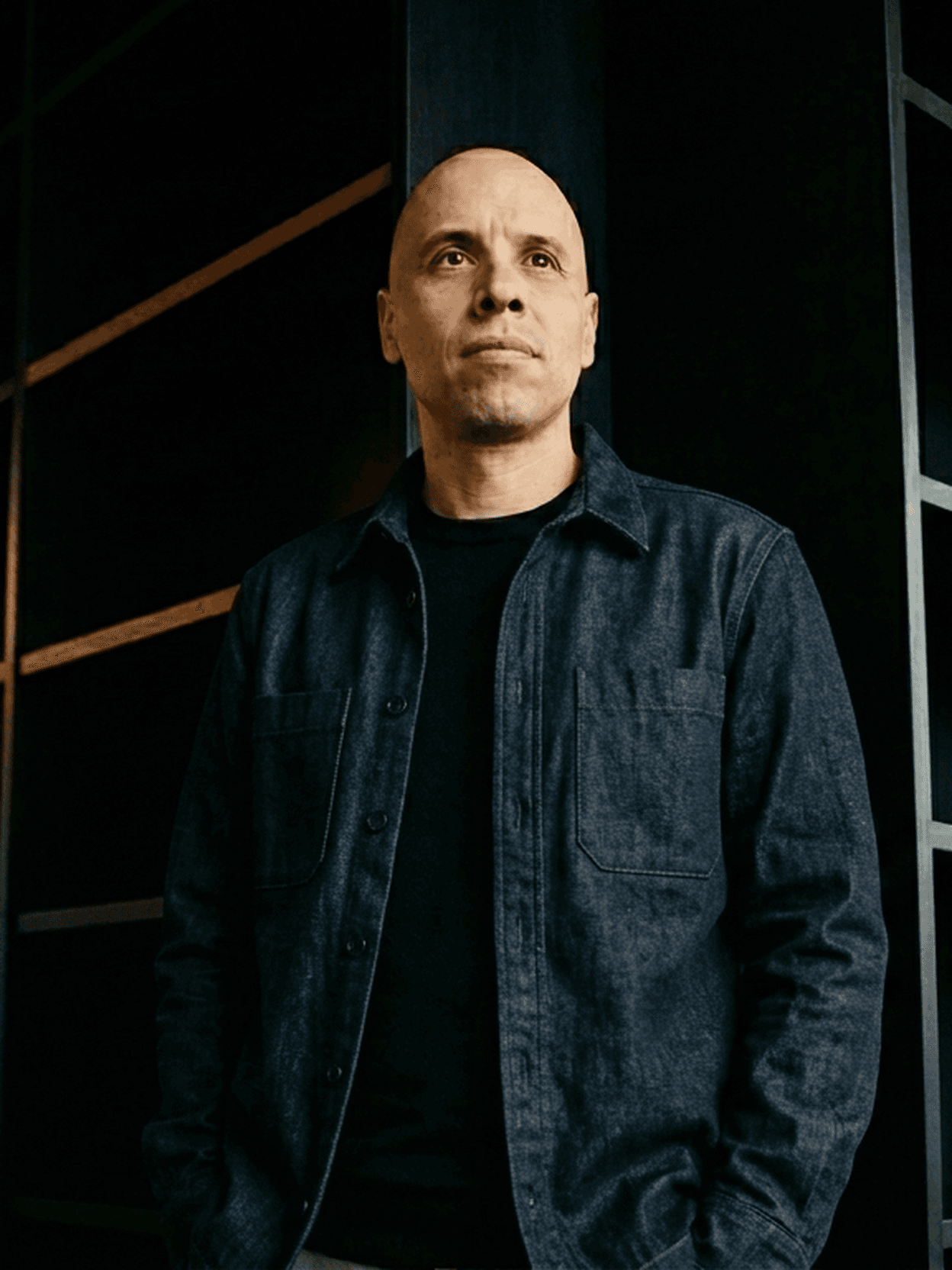
The Multiplier Myth — a conversation.
 Rutger
- Oracle
 Saar
Saar
Rutger and Oracle stress-test the central argument: AI is a multiplier only if you use it on the part of the work that compounds, not as a way to do the same job with fewer people.
00:00 / 12:24Op deze site: The Multiplier Myth.
Lees het transcript
- Rutger
- Welcome back to The Seam. I'm Rutger — and across from me, as ever, the only man alive who brings a deck to an audio podcast. Oracle.
- Oracle
- I prefer "framework architect." But I accept the room's affection.
- Rutger
- And back for a third time — the Netherlands' own, Saar.
- Saar
- Hello! I brought tea for everyone. Nobody warned me there'd be a quadrant.
- Oracle
- Saar. There is always a quadrant.
- Rutger
- [laughs] There's always a quadrant. Okay — let me set this one up, because I want to come at it from a strange angle today.
- Rutger
- Quick setup, in case you haven't read the piece. Everyone's talking about AI as a way to do the same work with fewer people — the cost saving, the eleven percent off the bottom line. That's the myth. The argument in the piece is: zoom out. For about forty years, every idea you ever had to had to squeeze through a *machine* to get out — a keyboard, a menu, a formula, a line of code. That friction was so normal we stopped seeing it. AI is the first time that layer is genuinely thinning. So the real question isn't "how few people do I need." It's "what can people finally make now that the machine isn't in the way."
- Saar
- Mm. I heard "fewer people" and then "make stuff." I'm choosing to focus on the nice half.
- Rutger
- [chuckles] Focus on the nice half — honestly, that's the whole episode. Oracle. You read it.
- Oracle
- I read it, and I have come *framed*. Because I'm afraid the nice half does not survive a board meeting. Let me zoom out —
- Rutger
- [overlapping] You can't zoom out, I just zoomed out, there's no more out —
- Oracle
- There is *always* more out, Rutger. At the meta-layer, every transformation resolves to one question: what survives the audit. "We removed eleven percent of cost" survives the audit. "We dissolved the friction between our people and their ideas" gets you walked to the car park.
- Rutger
- Right — see, that's the myth, said beautifully. You've already collapsed the whole thing back into a cost line.
- Oracle
- Cost is *legible*. Your friction is a feeling.
- Rutger
- Okay — so let me make it not a feeling. Saar. Can I do the thing with you.
- Saar
- The last time you did a thing with me, I accidentally explained an entire article and got no credit.
- Rutger
- [laughs] This'll be the same. Here — you've got a film in your head. The whole thing. The look, the feeling, the —
- Saar
- [jumping in] Oh, all the time. Constantly. I have a film in my head right now and it's better than most of what I get sent.
- Rutger
- Right — so what happens between that film in your head and it actually existing?
- Saar
- …Everyone else. [a beat] I have to explain it to the director. Who explains it to the DP. Who explains it to the gaffer. And the editor cuts it while I'm asleep. And by the end it's — it's lovely, but it's everyone's. It's been through twelve sets of hands and each one sanded a little off.
- Rutger
- That. That's the friction. Every set of hands, every tool, every step where you have to *translate* the thing in your head into a form the next person or the next machine can take —
- Oracle
- — is also where the value is *added*, Rutger. The DP is not friction. The DP is a craftsman.
- Rutger
- [thoughtful] No— well, no, yeah, agreed, that's— that's the careful bit, actually. 'Cause some of those hands do add, for sure. But a lot of the… the layer, I mean — it isn't craft. It's just… it's tax, right? It's the syntax. It's "I know exactly what I want, but first I've gotta go learn the menu." It's the marketer who can see the whole campaign and just… can't build the deck — so the idea sort of sits there two weeks, waiting for someone who can.
- Saar
- Mm. Or it just… dies. Most of mine die in the explaining.
- Rutger
- [quietly] Most of everyone's, though… most of everyone's die in the explaining. [a beat] That's — honestly, that's the line of the whole piece. She just said it again.
- Saar
- I do keep saying things. Nobody writes them down.
- Oracle
- [dryly] I am writing it down. I am putting it on a slide. The slide will say "Translation Loss" and it will have my name on it.
- Rutger
- [laughs] Course it will. Okay — keyboards. Hold that thought, let me make it concrete and slightly nerdy. For forty years the deal was: you have a thought, and to get it into the world you operate a machine. You type. You learn the spreadsheet. You learn the syntax of the program. The keyboard, the mouse, the formula bar — we call them "tools," but really they were the *border crossing* between a human and the thing they wanted to make.
- Oracle
- A border crossing with a craft to it. I was rather good at the formula bar.
- Rutger
- We all got good at the border crossing! That's— that's the trap, right? We got so good at paying the tax that we, we mistook it for the work. And now you can just… you can say the thing. Out loud. "Make me the version where it's warmer and there's only three of them." And it appears, and you go "no… warmer," like — like you're talking to a person.
- Saar
- [delighted] Wait — so it's like a really good crew that doesn't get tired and doesn't sand bits off?
- Rutger
- [a beat] …Saar, yes. That's exactly the good version of it.
- Oracle
- The good version. There is also the version where you fire the crew.
- Rutger
- And THAT — that's the myth, the exact wrong turn. Hold that thought — let me grab a quick word from the people quietly paying for all of this.
- Oracle
- I could do the read, you know. I have the voice for it.
- Rutger
- [chuckles] I know you do. Sit this one out.
- Oracle
- [flatly] Well. That is a smell I have not heard described before.
- Saar
- I still don't smell anything.
- Rutger
- [laughs] Nobody does, Saar. Okay — Oracle, you said "fire the crew." That's the fork in the whole thing, so let's actually stand in it. Two doors. Door one: the friction's gone, so I need fewer people to make the same forty things. Bank the saving.
- Oracle
- Door one is real. Door one has a number. I like door one.
- Rutger
- Door one is real and door one is small. Because here's the thing — everybody gets door one. Your competitor with the same tools gets the identical saving. You've spent the biggest shift in forty years to end up exactly where you were, only smaller and with fewer people who know anything.
- Oracle
- …And door two.
- Rutger
- Door two — you keep the people, and you point the freed-up energy at the ideas that used to die in the explaining. The forty things become four hundred attempts. The marketer who could see it but couldn't build it — now builds it on a Tuesday. The quiet one with the great taste and no technical hands suddenly has hands.
- Saar
- Oh — that's the residuals thing again, isn't it. [a beat] You do a commercial, they pay you once and ciao. You do a film, it pays you forever. Door one is the commercial. You want to be the film.
- Rutger
- …She did it again.
- Oracle
- [dryly] I find that deeply irritating.
- Rutger
- Yeah — yes — the cost saving pays you once. The new idea, the thing somebody could finally make — that pays you for years. Door one is a microwave. Door two is a kitchen that just got forty new cooks who'd been stuck washing dishes because nobody handed them a knife.
- Oracle
- [a long pause] …That's annoyingly good. But a board cannot spend "opportunity." It spends euros. This quarter.
- Rutger
- I know — no, and that's… [exhales] that's the honest tension, that's the realest thing you've said all night. The saving's a fact, and the opportunity's a… it's a forecast, yeah. Where I'd push is — hm — you don't have to take the small fact over the big forecast just 'cause the fact fits on a slide, you know? Spend a little of the saving *buying down* the friction for your people. And then… then measure what they reach that they just couldn't get to last quarter.
- Oracle
- [leaning in] So Monday. And do not say "it depends." A deck cannot close on "it depends."
- Rutger
- Ha — fair. Three things, all cheap. One — stop asking "how many hours did AI save us." Ask "what did somebody make this month that they physically could not have made before." If the answer's nothing, you walked through door one and called it transformation.
- Oracle
- One. Strong. I'll own it.
- Rutger
- Two — find the people with taste and no tools. Every org has them. The ones who always had the idea and never the keyboard. Hand them the thing. That's your multiplier — not the headcount you removed, the talent you finally unlocked.
- Saar
- [softly] …That's me. I'm the people with no tools.
- Rutger
- [gently] I know, Saar. That's kind of why you keep saying the article.
- Saar
- Huh.
- Oracle
- Two. Noted. Grudgingly moved. Three.
- Rutger
- Three — protect the crew that adds. Saar's right that twelve hands sand the idea — but some of those hands were the magic. Keep the craftspeople, cut the *border crossing*. Know the difference. The DP stays. The two weeks of waiting for someone to format a deck — that can go.
- Oracle
- Opportunity, the people with no tools, craft versus tax. Three clean inputs. I can build a deck on three. I will call it the Friction Dissolution Framework and there will, regrettably, be a quadrant.
- Rutger
- [laughs] There's always a quadrant. Give me your honest landing — where do you still actually disagree?
- Oracle
- …Honestly?
- Rutger
- Honestly.
- Oracle
- I think you're right, and I think the saving is going to win most rooms anyway — because it's Tuesday, the forecast is scary, and the slide is *so* clean. I'm going to keep selling door one. I'll feel bad about it. Slightly.
- Rutger
- [chuckles] That's the most honest thing you've said all year. And it's fine — the myth isn't "never save money." Sometimes the cut is survival, and that's real. The myth is believing the cut is the *win*. A healthy business, sitting on the first real drop in idea-friction in forty years, spending it to get smaller — that's the expensive mistake.
- Saar
- So nobody's getting fired?
- Oracle
- [sighs] Nobody is getting fired, Saar. Some of them are getting knives.
- Saar
- [happily] I'd like a knife.
- Rutger
- [laughs] You'll get a knife. Right — I have to do the bit.
- Oracle
- Ah. The compliance slide. Allow me, I do these beautifully. [crisp] None of this is a Google position. It's Rutger's read, on Rutger's site. The voices are synthetic — including, unsettlingly, his. I am a character. And an invoice.
- Rutger
- [laughs] You left out Saar.
- Saar
- Saar is available for the right project. Preferably one where she keeps the knife.
- Rutger
- That's our button. Stop counting the people you can remove. Start counting the ideas that used to die in the explaining — and go make them. Goodnight.
 S0 · E3
The Thirty-Minute Kitchen — with Frits.
- Rutger
- Frits
Frits the Nestor pushes back on the title, then agrees with most of the article anyway. The kitchen is the prep line, not the meal.
00:00 / 13:16Op deze site: The Thirty-Minute Kitchen.
Lees het transcript
- Rutger
- Welcome back to The Seam. I'm Rutger, and today we're chewing on something I can't stop thinking about. And to chew on it with — the man I'd most want in the room — Frits.
- Frits
- I am here under protest and on my second coffee. The protest is the coffee.
- Rutger
- It's good to see you, Frits.
- Frits
- It is good to be seen, jongen. At my age that is no longer guaranteed.
- Rutger
- You read the piece.
- Frits
- I read the title. The title insulted me. So naturally I read the rest, to confirm the insult.
- Rutger
- [laughs] And did it hold up?
- Frits
- We shall find out together. On the radio. Which is what this is, no matter what you call it.
- Rutger
- Quick setup, in case you haven't read the piece. The argument is simple: most of the underperformance I see in enterprise marketing isn't a missing tool — it's a missing tuning. The board's reflex is to tear out the whole kitchen — new agency, new stack, an eighteen-month RFP — when the empirical data says that's the most expensive mistake in the playbook. Sharpen three knives — your data plumbing, your creative supply chain, your media operating model — and you fix most of it in an afternoon, on the existing budget, with the team you already have.
- Frits
- Thirty minutes.
- Rutger
- Mm-hm.
- Frits
- To make what, exactly.
- Rutger
- Not to make the work. To tune the room before you start.
- Frits
- [dryly] Ah. The room.
- Rutger
- Coffee?
- Frits
- Black. As black as the future of the industry, please. No, blacker. The future of the industry has at least a little milk of hope in it. Mine does not.
- Rutger
- [laughs] We haven't even started.
- Frits
- I am pacing myself. A man my age does not sprint into despair. He strolls. [a beat] Thirty minutes. You read me the title in your little summary and I was insulted all over again. Then I remembered I read the rest of it, on the train, three times — and I was, I would say, only mildly insulted. And a little ambushed.
- Rutger
- Mildly insulted is my professional zone.
- Frits
- No—listen, jongen. [sighs] Nineteen ninety-four. I shot a beer spot. One spot. Sixty seconds. We were six weeks on it. Storyboards papering the whole wall, three rounds with the client, casting, a location scout, a smoke machine, and a boy in Antwerp — twenty-two years old — who knew how to mist a bottle so the condensation read like a Dutch summer instead of a German one. There was a craft. There was a tempo. There was a *room* full of people who cared whether the light was right. And then you arrive, and you tell me the kitchen — the kitchen — can be tuned in thirty minutes. I felt it as a personal injury.
- Rutger
- [a soft laugh] I believe you. Did you finish the article.
- Frits
- I finished the article. Yes. Against my dignity.
- Rutger
- And.
- Frits
- Ah—but here is the thing. Your cook did not cook faster. That is the thing that got me. He arrived with his own three knives. He sharpened them on the counter. He moved one cutting board so the prep line ran straight. And then he cooked for two hours, like a Christian.
- Rutger
- Correct.
- Frits
- So the thirty minutes is not the meal.
- Rutger
- No.
- Frits
- The thirty minutes is the part *before* the meal.
- Rutger
- Exactly.
- Frits
- No—then why, in God's name, did you call it thirty minutes? You are a marketer, Rutger. You know precisely what a number does in a headline. You put a thirty in front of a kitchen and the whole industry reads it as: the meal is thirty minutes, the chef is obsolete, and the boy in Antwerp can go home.
- Rutger
- [exhales] …That's fair. I mean — yeah. The article's more careful than the title. It always is.
- Frits
- Hah—the article is always more careful than the title. The title is what they quote at me in the elevator at the Adformatie do, the young ones, with their lanyards. The article is what I read alone on the train, with a small glass of port, while the man across from me eats a sandwich and judges the port. Different audiences entirely.
- Rutger
- Right. Title aside, then — what's the part that lands for you?
- Frits
- Mm. The three knives. That part is — hm. Fine. It is more than fine; it is almost beautiful, and I resent it. I had three knives. I still have three knives. They are in a roll in my bag. I did not tell you that.
- Rutger
- [a soft laugh] I assumed.
- Frits
- One paring, one chef, one slicer. I would die for these knives. [chuckles] I will probably die *because* of these knives. At the security line at Schiphol, in front of a child who has never heard of me.
- Rutger
- [thoughtful] So the metaphor in the piece is — the three knives are, well, clean data, documentation a machine can actually read, and a workflow that reaches your execution layer without a person copy-pasting in the middle. That's the prep line. That's… that's not the meal.
- Frits
- Mm. The boy with the bottle did not need a workflow. He needed an eye, and a steady hand, and a German bottle to make look Dutch.
- Rutger
- —But he needed clean condensation. Same instinct, right? Clean inputs. What's the part that *doesn't* land?
- Frits
- The renovations. You say agencies tear out a kitchen when they should sharpen a knife. I understand the metaphor. But you forget, jongen, that some of those renovations happened because the kitchen was — in point of fact — on fire.
- Rutger
- …Sometimes.
- Frits
- No no—often. We had a vodka, around two thousand and eight. The kitchen — by which I mean the agency — was fully alight. Three account directors gone in eight months. Strategy outsourced to a consultancy in Hamburg who insisted on calling the brand "the product." A renovation was the only honest answer. You cannot sharpen your way out of a building that is burning.
- Rutger
- Right—agreed, and the piece allows for that. It just notices that, well — most teams reach for the renovation when the actual problem is — the salt is in the wrong cupboard.
- Frits
- —The salt is in the wrong cupboard. [a long pause] Yes. I will give you this one, and it will cost me. I have watched, with my own eyes, a thirty-million-euro media review get triggered because a CMO could not find one number in a dashboard. He tore out the entire stack. New agency, new tools, new everyone. [sighs] The number was in the next tab.
- Rutger
- Mm. That's the article in one sentence.
- Frits
- Hm.
- Rutger
- Hm?
- Frits
- I am thinking. Allow an old man the dignity of a silence.
- Rutger
- Take your time. Actually — take it during the break. Let me steal a moment for the people who keep the coffee, bad as it is, free.
- Frits
- [dryly] A framework practice. Of course. In my day we called that "having an idea," and it was complimentary.
- Rutger
- [laughs] Right where we left off — you were having a dignified silence.
- Frits
- I was. And I have used it well. Your cook — he does not work in less time than the cook before him. He works in roughly the same time. He simply does not spend two of his hours fighting the room.
- Rutger
- Right.
- Frits
- So—no, here's the thing—the gain is not speed. The gain is the, well — the *absence of friction*.
- Rutger
- Mm. That's a better way to say it than I — honestly, better than I said it in the piece.
- Frits
- —Yes. It is. [quietly] And I notice it is also the saddest way to say it. Because the friction — the fighting the room, the six weeks, the three rounds, the boy in Antwerp — that friction was where I *lived*, Rutger. That was the job. You are telling me the work is better when you remove the part that was my whole life. And the worst of it is — the worst of it is, you are right.
- Rutger
- [a beat] …That's the line, isn't it.
- Frits
- There is a thing they say, in that show about the men who made the advertisements — the American one, with the drinking, which got us all entirely wrong and which I have watched four times. *"You are not good because you are old. You are old."* I rewatch it precisely to be wounded. [dryly] I would like a credit on the next version of the article.
- Rutger
- [laughs] You're getting a credit on the podcast.
- Frits
- Mm. I am suspicious of podcasts. The medium flatters the host and uses the guest as upholstery.
- Rutger
- I'll let that one pass.
- Frits
- Generous. It is the only currency the young have left.
- Rutger
- One last thing. The piece says the answer is rarely an RFP. Forty years in agencies — what's your take?
- Frits
- [exhales] Ah—my take is that the RFP *is* the renovation. The RFP is — it's the morning the CMO decides to tear out the wall rather than, you know, sharpen the knife. By the time it hits the street, honestly, three honest conversations would have solved seventy percent of it. But three honest conversations have no budget line, no procurement department, and no single internal owner brave enough to put his name on "I think we were just holding it wrong." So we tear out the wall. [sighs] Every time. It is easier to spend thirty million than to admit the salt was in the wrong cupboard.
- Rutger
- [exhales] That's bleaker than my article.
- Frits
- Hah—I am older than your article. That is permitted. The old are allowed one bleakness per visit.
- Rutger
- So — where do you actually land. Honestly.
- Frits
- [a beat] …Honestly. I — I came in to defend the six weeks. [exhales] And the truth is the six weeks are not coming back, and… and most of them were never about the work — half of those weeks were me fighting the room, like your cook's two wasted hours. So your little article is right about the kitchen. It is right about the salt. And it is right that the gain is the friction leaving. I only wish — [a beat] I only wish it were not, because I was very good at the friction.
- Rutger
- Mm. That's the most honest thing anyone's said about the piece.
- Frits
- No—do not quote me. Or — do. At my age the danger is no longer that they quote you. It is that they stop.
- Rutger
- Frits. Thanks for coming in.
- Frits
- Was that thirty minutes?
- Rutger
- Forty-three.
- Frits
- A renovation, then.
- Rutger
- A small one.
- Frits
- [softly] A small one. Yes. The last good kind.
 S0 · E4
Agent Inclusive — with Angela and Saar.
- Rutger
- Angela
- Saar
Angela the chief of staff, calm and procedural, walks through what "Agent Inclusive" actually means in a real org: keep one human in the room who can write a real brief.
00:00 / 12:42Op deze site: Agent Inclusive.
Lees het transcript
- Rutger
- Welcome back. I'm Rutger. Fair warning: today's one started as an argument and stayed one.
- Angela
- It started as a piece you wrote and an afternoon I will not get back. But yes. An argument.
- Rutger
- [laughs] That's Angela — she keeps the European office standing, and me honest. And joining us, sunshine in human form —
- Saar
- Hi everyone! I don't know what we're talking about yet, but I'm wearing the right outfit for it.
- Angela
- [flat] You are. It is a very capable outfit.
- Saar
- Thank you. It tests well.
- Rutger
- [chuckles] Okay. Two questions, one decision, let's go.
- Rutger
- Quick setup, in case you haven't read the piece. The argument is this: as AI agents take on more of the actual execution — the drafting, the building, the doing — the job that stays human moves up a level. It becomes writing the brief. Turning a fuzzy "make it good" into a spec precise enough that an agent can run with it. So "agent inclusive" isn't about removing people. It's about keeping the one person in the room who can say, exactly, what good looks like — and building the team so a non-human teammate can sit down on day one without anyone translating the room for it. Angela, you read it on the train. You came in loaded.
- Angela
- Four questions and a hard stop at six. If we are efficient, everyone gets dinner.
- Saar
- My agent told me to come. He said, "Saar, it's about agents, you'll be wonderful." So I cleared the whole afternoon.
- Rutger
- [chuckles] Ah — Saar, when I say agent I mean a piece of software. Not the person who books your auditions.
- Saar
- Mm. Yes. Software. [warmly] Keep going, darling. I'm following.
- Angela
- Question one is the title. "Agent Inclusive." Rutger — you know what the word "inclusion" does in a company. It has a job. You have parked it next to "agent," and now I have to explain the parking to people who do not have time for it. That is, in my notes, a risk. Can we agree it is a risk and move on?
- Rutger
- Mm — fair. I'll grant it's a risk. [thoughtful] But I kept it — I kept it on purpose, and I'll defend it once, quickly.
- Angela
- One minute. I am watching the clock, lovingly.
- Rutger
- Here's the defence. [a beat] We've spent decades — I mean, decades — designing companies around people. Onboarding, escalation paths, performance reviews. And the second an AI system drops into the same workflow… none of that scaffolding fits it. So things quietly break. "Agent inclusive" forces the question now, while the human team is still in the room. Not after.
- Angela
- Mm.
- Saar
- Ah — an inclusive agent. God, I'd love one. Mine forgot my birthday and booked me a yoghurt commercial. In Düsseldorf.
- Angela
- [flat] I have run an office near Düsseldorf.
- Saar
- Ah. Then you know.
- Angela
- I know more than I would like. [a beat] Fine. The title is a risk we are accepting with our eyes open. Noted. Question two — and this is the one that kept me on the piece. You write it like good news. "The next teammate, human or not." Rutger, I have sat through every restructuring this office has had in fifteen years, and that exact sentence was on the slide every single time. Right before a slightly long pause.
- Rutger
- Yeah. [sighs] I've been in those rooms too. That read is fair.
- Angela
- Mm.
- Rutger
- But it's not the only read. The alternative — pretend the tools don't exist, or quarantine them in some "innovation lab" off to the side — that costs jobs too. Slower, quieter, more of them. Because by the time the team notices the work has migrated to the tools, the team didn't get the chance to migrate with it. This is about keeping people in the loop earlier, not walking them out.
- Angela
- Mm. So your claim is: name it now, with the people present, or lose them later by accident.
- Rutger
- That's the claim.
- Angela
- I will note that as the actual argument, rather than the title. Thank you. That at least I can take into a room.
- Saar
- Oh — so you want the agent in the room. For the casting. [delighted] That's clever, actually. Mine never comes. Last reading I did it across from a wall.
- Angela
- A — wall.
- Saar
- A production assistant holding the other lines. Read them like a parking ticket. No chemistry. I cried real tears at a wall.
- Rutger
- [laughs] — No, wait, hold that, actually. The wall's closer to the point than you'd think.
- Angela
- Three minutes left in my goodwill. Continue.
- Rutger
- I will — and I'll spend a few seconds of it letting someone pay our rent. Quick word from a sponsor.
- Saar
- Oh, I like that one. I'd repaint a whole room on the strength of that.
- Angela
- [dry] Noted as a non-action item. Rutger — the part that matters.
- Rutger
- Right. Here's the part that matters. The agent is getting genuinely good at the doing — the execution, the draft, the build. So the job that stays human moves up a level. It's writing the brief. Turning a fuzzy "make it good" into a spec precise enough that an agent can actually run with it.
- Angela
- Mm. A specification. With an owner. So when it is wrong, someone is accountable, by name.
- Rutger
- Exactly that.
- Angela
- Then let me ask it straight, because this is question three and I would like a real answer. The piece says design the team "so the next member, human or not, can sit down without flinching." Lovely. What happens, in your design, when the agent is wrong?
- Rutger
- Wrong how?
- Angela
- Wrong the way only these systems are wrong. Confidently. Politely. Perfect grammar. And the human — who has been told this thing is a teammate — is the one who has to push back. People do not push back on confident colleagues. Especially expensive ones the company just installed.
- Rutger
- — Ah, yeah, no, that's… that's the right question. And honestly the article doesn't answer it hard enough.
- Angela
- I noticed. I underlined it.
- Rutger
- So here's the answer I'd add. [thoughtful] The brief isn't just instructions for the agent — it's… well, it's the standard you check the agent against. Somebody human has to be able to say, precisely, what good looks like. Not "I'll know it when I see it." Written down. In advance. [a beat] That's the one human you cannot remove — because the agent can produce a thousand confident wrong answers, and only that person can tell which one is right.
- Angela
- [a beat] Mm. So the role you are protecting is not "person who does the work." It is "person who can say exactly what good is."
- Rutger
- That's the whole episode in one sentence. Yes.
- Saar
- Oh — that's just a good agent, though. A good agent reads the brief before the audition. The role, the wardrobe, the tone. So you don't walk in and play it sad when they wanted funny. You read the brief first. Then you book the job.
- Rutger
- — No, but, wait. Saar. That's… that's it. That's almost exactly the whole thing.
- Saar
- Is it? [pleased] I do find these afternoons relaxing.
- Rutger
- Yeah — I mean, somebody writes the brief so the talent doesn't do the wrong scene, confidently. Swap "audition" for "the work" and… you've got the entire argument. The brief comes first, or the agent walks in and nails the wrong thing.
- Angela
- [a beat, dry] That was not a bad sentence. From the room with the earrings.
- Saar
- [laughs] Thank you. People underestimate me at parties too.
- Angela
- [a beat] Then I will land it. This framing — "agent inclusive" — I do not love, and I will not love it tomorrow either. But the practice underneath it — write the brief before the tool arrives, name the human who owns the standard — that is the step I have watched a hundred companies skip. Then they call my office to clean it up. If the title is the price of the practice, I will pay the title. Can we make that the decision and put it to bed?
- Rutger
- That's generous.
- Angela
- That is not generous. That is me wanting to leave. There is a difference, and the difference is dinner.
- Rutger
- [a soft laugh] Understood.
- Angela
- One more, and then I am gone. The phrase "the team of the future." If it appears on your slides at the next conference, I will know something went wrong in this room. Promise me you will not say it.
- Rutger
- [exhales] I promise I will not say it.
- Angela
- Then I have a decision, two action items, and a train. [a beat] Write the brief first. Name the owner. Those are the two items.
- Rutger
- That's the show, honestly. Forget the title — Angela's right about the title. [thoughtful] It comes down to… one line on the org chart. A named human who can write the brief and say exactly what good looks like, and catch the agent when it's confidently, politely wrong. No name in that box and you don't have agent-inclusive anything. You have a tool somebody installed. For the record — this is my read, on my site, synthetic voices. Angela's a character. Saar is —
- Saar
- Saar is available for the right project.
- Angela
- Saar, your agent is software now. We decided.
- Saar
- [warmly] We did? Oh, lovely. I'll tell him. He's terrible, but the brief comes first now. I taught him that.
- Rutger
- [laughs] Write the brief first, Saar.
- Saar
- Always have, darling. Always have. Goodnight.
 S0 · E5
Forty Volunteers and a Dragon — with Marie.
- Rutger
- Marie
- Angela
Rutger's raid piece flushes out a secret: Marie, the compliance researcher, was a top World of Warcraft raider too. They nerd out — and then Marie makes the case to Angela for what HR should actually steal from MMORPGs.
00:00 / 10:15Op deze site: Forty Volunteers and a Dragon.
Lees het transcript
- Rutger
- Welcome to The Seam. I'm Rutger, and I promise we get somewhere by the end. Angela — chief of staff, runs a European office, here under mild protest.
- Angela
- I'm here because the invite said thirty minutes. I want that on the record before we start.
- Rutger
- Noted. And Marie — the one person who settles a brand argument by simply being right.
- Marie
- Mm. Usually.
- Rutger
- [laughs] "Usually." Okay — quick setup before I let you two at me.
- Rutger
- The piece is about a World of Warcraft raid I was in twenty years ago — forty people, unpaid, no contracts, no HR, killing a dragon together on a Tuesday night. Strip out salaries and you can't lean on any of the usual levers, so the *systems* have to carry everything: an economy that keeps the floor high, blameless logs, and a bar so steep that belonging enforced it. It was one of the best teams I've ever been on. I've spent two decades wondering why — and it turns out one of you was in that world too.
- Marie
- I was.
- Rutger
- Twenty years next to you, and that's how I find out.
- Marie
- A Few Good Men. You were realm-second on the Twin Emperors.
- Rutger
- …Marie.
- Marie
- Resto druid. Different guild. I have the logs.
- Rutger
- [laughs] Of course you have the logs.
- Marie
- I have everyone's logs.
- Angela
- I'm sorry — is this a work meeting? I have a three o'clock.
- Rutger
- Angela, hang on — Marie *raided*. At the top. I had no idea.
- Marie
- You never asked. People don't.
- Rutger
- Okay — settle one thing for me. C'Thun. Pre-nerf or post.
- Marie
- Pre. We wiped for three weeks. The eye beam pathing was broken.
- Rutger
- [laughing] It was broken! Twenty years and nobody believes me — thank you —
- Marie
- — It was not "hard." It was broken. There is a difference and I logged it.
- Angela
- [flatly] I understand none of these words, and I want that on the record.
- Rutger
- Fair. Quick translation, Angela — a raid is forty people, unpaid, executing a complex sequence perfectly, together, or everybody fails at once. No salaries. No HR. No way to fire anyone.
- Angela
- So, a nightmare.
- Marie
- A high-performing organisation. That's the point.
- Rutger
- That's the point. And honestly — the systems that made it work are, I mean, they're better than most of what I've seen in companies with actual budgets.
- Marie
- [cutting in] — Angela. You run people. You should be studying this.
- Angela
- I should be in my three o'clock.
- Marie
- One thing first. The logs.
- Angela
- [sighs] Go on.
- Marie
- We recorded every action. Every player, every fight. All of it, visible to everyone.
- Angela
- That's surveillance. HR cannot log every keystroke. Legally or otherwise.
- Marie
- Wrong frame. The log had no consequence. Never used to punish anyone. Ever.
- Angela
- [skeptical] Mm.
- Rutger
- Right — and that's, honestly, that's the part that matters. [thoughtful] You'd see your own mistake before anyone said a word. Fix it, move on. The data existed to fix the *next* pull, not — not to litigate the last one.
- Marie
- Total transparency. Total safety. At the same time.
- Angela
- Nobody does both.
- Marie
- Nobody does both. We did. That's why we got better and your annual review cycle doesn't.
- Angela
- [dryly] I'll let that go because I'm slightly afraid of you.
- Rutger
- [laughs] Smart.
- Marie
- [pressing on] Second thing. The bench.
- Angela
- [bracing] I can't bench an employee.
- Marie
- You bench people constantly. You call it "reprioritisation" and pretend it's about the work.
- Angela
- …That is a deeply unfair characterisation that I will be thinking about all weekend.
- Rutger
- [chuckles] But the raid version was clean — the roster was bigger than the team, so a seat was contested every single night. A spot you can lose is a spot you respect.
- Marie
- And nobody got fired. They sat. Then earned it back. Visibly.
- Angela
- My people have mortgages. A "bench" with no pay is not a bench, it's a layoff with extra steps.
- Marie
- Correct.
- Angela
- …Thank you.
- Marie
- The pay part doesn't transfer. The *safety* part does. Copy the safety, not the volunteering.
- Rutger
- That's — well, that's actually the whole trick, Angela. [a beat] We were volunteers, so the only currency, really, was whether the thing was fair and worth the evening. And, I mean, strip out the salary and you can suddenly *see* the parts of your culture that were only ever held together by… by the salary.
- Angela
- [pause] …That one's slightly annoying because it's slightly true.
- Marie
- [quick] Third. Loot.
- Angela
- [flatly] Loot.
- Rutger
- How you hand out the rewards. We built our own points system. And the interesting bit — your points never made anything *cheaper*. Everyone paid the same. What seniority bought you was priority. First in line, not a discount.
- Marie
- [jumping in] — And it decayed. Bank points for three months, they bleed out. Standing tracked what you did *lately*.
- Angela
- Ah — so no resting on an old win.
- Marie
- No resting on an old win.
- Angela
- [quietly] We have a director who has been resting on a 2019 win for five years.
- Rutger
- [laughs] Everyone does. That's the point. We reward tenure with a better *deal* and then — and then act surprised when it turns into entitlement. The raid rewarded it with *priority* — and, you know, let the standing expire.
- Marie
- New players got a starting pack. Geared fast. So the floor came up.
- Rutger
- Mm — and the floor, honestly, the floor is the whole game. A boss doesn't die because one person was brilliant. Forty people clear a minimum bar at the same second. So you protect the floor… not the ceiling.
- Angela
- [dryly] Most of what I'm paid to do protects the ceiling.
- Marie
- [flatly] I know. I've seen the comp bands.
- Angela
- [flatly] You've seen the — of course you have. You've seen everyone's logs.
- Marie
- I've seen everyone's logs.
- Rutger
- [laughs] On that genuinely unsettling note — let me take a quick break for the people who keep the lights on around here.
- Angela
- [flatly] I have no idea what that was, and I have notes on it anyway.
- Rutger
- [chuckles] That's the most engaged I've seen you all meeting, Angela. Okay — back in. There's one more, and it's the one I'd actually frame on a wall. After about three years, we were burning out. So instead of grinding harder, we capped it. Three hours a day, four nights a week. Not a minute more.
- Marie
- And we stayed realm-first anyway.
- Rutger
- We got *sharper*. Fewer hours forced better prep. Smaller egos. Fewer wasted attempts.
- Angela
- [slowly] Wait. You bounded the hours, and performance went up.
- Marie
- Performance went up.
- Angela
- [a beat] I have spent fifteen years being told the opposite by people who bill by the hour.
- Rutger
- Right. Unbounded intensity *feels* like performance. For a season it even, you know, it even looks like it. But — [exhales] but it's a phase, and it burns the exact people you most want to keep.
- Angela
- [long pause] Right. Here's where I land. Four of these five are a game, and people are not volunteers with night elves.
- Marie
- Fair.
- Angela
- But the blameless log. Measurement with no punishment attached. *That* one I'm taking to the offsite. That one's real.
- Marie
- [quietly pleased] One out of five.
- Angela
- One out of five.
- Marie
- [deadpan] For you, Angela, that's euphoria.
- Rutger
- [laughs] I'll take it. And honestly — one is enough. I mean it. If HR ran one genuinely blameless measurement, just… just one, it would change the whole building.
- Angela
- It would also change my three o'clock, which I am now thirteen minutes late for. I'm noting that as a risk.
- Rutger
- Go. Last thing for the record — none of this is a Google position; it's my read, on my site, synthetic voices. And Marie is a character who, apparently, raided.
- Marie
- Realm-second. I want that in the episode.
- Rutger
- [a soft laugh] It's in the episode. Angela — go protect a floor.
- Angela
- I'm going to go protect my calendar. Mm.
 S0 · E6
The Evolution of Video Models — three ways in.
- Rutger
 Celestin
- Marie
An explainer, three ways: Rutger reaches for the metaphor, Dr. Célestin Mukeba (a daily Veo power user, giddy about Omni) explains from the hands, and Marie just wants to understand it — and find the marketing use. One topic, three doors.
00:00 / 10:04Op deze site: The Evolution of Video Models.
Lees het transcript
- Rutger
- Welcome back to The Seam. I'm Rutger — and today I actually want to *learn* something on the air, so I've brought two people who learn it completely differently. To my left, a man who needs no introduction in about forty countries — neuroscientist, runs the biggest thinking-person's food channel on the internet, and, it turns out, a complete addict of generative video. Dr. Célestin Mukeba.
- Celestin
- [warm] Rutger. It's a joy. Although "addict" is strong. I prefer… enthusiastic daily user. With a problem.
- Rutger
- [laughs] And — keeping us all honest, as ever — Marie.
- Marie
- Hello. I'm here to understand it. Not to be sold it.
- Celestin
- [delighted] That is the correct attitude. I will try to earn it.
- Rutger
- So here's what this is, if you're just joining. We're trying to actually understand the new wave of AI video — the Veo lineage, and the new interactive one, Omni. And instead of one explainer voice, you get three ways in. I reach for metaphors till it clicks. Célestin actually uses this stuff every single day. And Marie wants to know what it's *for*. Three people, one topic, three completely different doors. Let's see which one gets us inside.
- Marie
- I give it twenty minutes.
- Rutger
- Okay. Célestin — start me at the beginning. Pretend I've heard the words "AI video" and nothing else. What actually *is* the thing.
- Celestin
- Simplest version: you describe a moving image in words, and a model gives you back a few seconds of video. "A slow push-in on a bowl of ramen, steam rising, warm window light." A few seconds later — there it is. Moving. Lit. Real-looking.
- Marie
- From just the sentence. No footage.
- Celestin
- No footage. No camera, no kitchen, no steam. It has watched enough of the world to imagine what that sentence should *look* like, moving.
- Rutger
- See, this is where my brain reaches for a — hold on, let me find it. It's like… [thinking] it's not a camera, it's more like… a very, very well-read film crew that has never left the building. You describe the shot, and they go "ah, yeah, one of those," and they just… produce it. From memory. From everything they've ever seen.
- Celestin
- [pleased] That's good. That's actually close to what's happening in there.
- Marie
- Mm. And at the start — be honest — it was rough.
- Celestin
- Oh, at the start it was a charming disaster. Six silent seconds, and if a hand reached for a cup the hand might have… six fingers. Beautiful light, nightmare anatomy. But watch the lineage — and this is the part people miss — each step didn't just get prettier. Each step fixed a *sense*. First it learned to hold an object still without melting it. Then it learned longer shots. Then — and this was the big one for me — it learned *sound*. The clip arrives with its own audio. The footsteps match the feet.
- Rutger
- Wait — it generates the sound *with* the picture? Not added after?
- Celestin
- With it. Same breath. Which, to a neuroscientist, is the interesting bit — because that's how *you* work. Your brain doesn't record sound and vision on two tapes and sync them later. It builds one event. The model started doing the same thing.
- Marie
- [a beat] …Okay. That's a better explanation than I expected.
- Celestin
- [warm] I get that a lot. Usually phrased less kindly.
- Rutger
- [laughs] So where does Omni come in? Because you got genuinely excited on the phone about Omni.
- Celestin
- Omni is the one I can't stop using. Everything before it, you wrote one perfect prompt and prayed. One shot. Like ordering a dish by letter and hoping the kitchen reads your mind. Omni is a *conversation*. You generate, you look, and you say "good — now move the camera left, keep everything else." And it does. And you say "now it's evening." And it's the same scene, in the evening. You're not re-rolling the dice. You're *directing*. Turn by turn.
- Rutger
- Oh — okay, that's the metaphor, that's the whole thing right there. It went from a vending machine to a — to an actor. You don't re-buy the actor, you give the actor a note. "Again, but sadder." "Again, but slower." And they *remember* the last take.
- Celestin
- [genuinely lighting up] Yes! And the remembering is everything. That's the leap. Continuity. It holds the world steady while you change one thing.
- Marie
- [quiet, a little impressed] …Huh.
- Rutger
- Marie. That "huh" was almost enthusiasm.
- Marie
- It was a "huh." Don't push it. [a beat] But — okay. Here's mine. Because it's lovely that he can make evening ramen. What do I *do* with this? On a marketing team. Monday. Be concrete.
- Celestin
- Ah — good. Honest question, honest answer. Three things, off the top of my head, that I actually do. One: concepting. You have an idea for a campaign — you used to draw a stick-figure storyboard and hope the room imagined it. Now you show them the *moving* version, in an hour, before anyone's spent a euro on a shoot.
- Marie
- So you test the idea before you fund it.
- Celestin
- Exactly. Two: variation. The hero film is shot, it's real, it's expensive — but now you need it warm for one market, cooler for another, a vertical cut, a fifteen, a six. The boring, infinite versioning that used to eat a week —
- Marie
- [cutting in] — that's the part everyone underestimates. The versioning is most of the actual job.
- Celestin
- [nodding] It *is* the job. And three — and this is the one I love — you can previsualize a thing that would be impossible or insane to shoot. The product floating through the surface of the ocean. The city built out of the cereal. You see it, you feel whether it's any good, and *then* you decide if it's worth doing for real.
- Marie
- [a beat] That's… genuinely useful. All three of those are real.
- Rutger
- Hold that — Marie agreeing twice in one episode, someone mark the tape — let me grab a quick word from the people quietly paying for all of this.
- Rutger
- [coming back] Right. We're back. Célestin — let me push on the exciting one, because I want to make sure we're not just being dazzled. Omni, the directing thing. What's the catch?
- Celestin
- [thoughtful] The catch is the same catch as everywhere else, honestly. The model will happily give you a *competent* version forever. Smooth, plausible, fine. The taste is still yours. It keeps the beat — flawlessly — but the swing, the choice of *which* evening, *which* note to the actor… that's you. If you don't bring a point of view, you get beautiful nothing. At scale. Instantly. Which is its own kind of danger.
- Rutger
- That's the thing I keep landing on with all of this. The tool got incredible at the *how*. Which means the only thing left that really matters is the *what*, and the *why*. The judgment.
- Marie
- So the skill isn't prompting. It's knowing what's good.
- Celestin
- [warmly] Marie. Yes. That's the entire sentence. It was always that. We just used to be able to hide behind the difficulty.
- Marie
- [a beat, then almost grudging] …You're very good at this, you know. The explaining. I came in to be skeptical and I've written down four things.
- Celestin
- [genuinely touched] That — coming from you, I'm told — is a standing ovation. Thank you.
- Rutger
- [laughs] It really is. She fact-checks the weather. Okay — land it for me, both of you. Célestin, one line: why should someone who isn't a film person care?
- Celestin
- Because the gap between "I can picture it" and "I can show you" just collapsed. For everyone. That's not a film story. That's a *human* story.
- Rutger
- Marie. One line.
- Marie
- Stop calling it a video tool. It's a previsualization tool that happens to output video. *That's* the use case.
- Rutger
- [pleased] Ooh. That's better than mine. Mine was just "it's an actor with a memory." Right — I have to do the bit.
- Celestin
- Of course. The honest part.
- Rutger
- None of this is a Google position — it's my own read, on my own site. The voices here are synthetic, including, a little uncannily, mine. Célestin is a wholly invented character — a fictional neuroscientist who cooks. And Marie —
- Marie
- Marie is real enough to remain unconvinced about most things. Just not, annoyingly, about this.
- Rutger
- [laughs] That's our button. Three doors, same room — the metaphor, the use, and the person who actually uses it every day. Go make something you could only picture before. Goodnight.
 S0 · E7
Interactivity Is The New Explanation — a panel.
- Rutger
- Oracle
- Marie
Strategy Oracle defends slides. Marie keeps everyone definitionally honest. The article's argument lands with one notable caveat: live demos give up the frozen argument.
00:00 / 10:30Op deze site: Interactivity Is The New Explanation.
Lees het transcript
- Rutger
- Welcome in. I'm Rutger — coffee's bad, company's good, let's get into it. With me, Oracle — strategist, framework architect, owner of the only statement turtleneck in the building.
- Oracle
- A pleasure. I've prepared a deck nobody will see, which is when a deck is purest.
- Rutger
- And Marie — the one who reads the evidence so the rest of us don't get to make things up.
- Marie
- Mm. Someone has to.
- Rutger
- She'll speak four times all episode and win every exchange.
- Marie
- Three times. You're padding.
- Rutger
- [laughs] Noted. Okay — quick setup.
- Rutger
- For anyone who hasn't read the piece: the argument is that interactivity is becoming the new way to explain. When something's genuinely new — a tool, an AI workflow, an idea the room has no model for yet — a live, playable thing beats a static slide. You don't describe the loop; you hand someone the steering wheel for thirty seconds and watch their face change. The honest caveat the piece concedes is that a demo gives up the control of a frozen, signed-off argument — and that's exactly the hill Oracle wants to defend.
- Oracle
- I do not defend hills, Rutger. I defend *positions*. But yes.
- Marie
- And I've brought one question. With a follow-up.
- Oracle
- And I, naturally, have a deck. I've brought it in spirit, out of respect for your no-screens policy. The deck is present. The deck is simply choosing not to be seen.
- Rutger
- [chuckles] It's audio, Oracle. The deck was never going to be seen.
- Oracle
- And yet it shapes the room. That's the genius of the deck.
- Rutger
- Mm. Two little interactive demos sit right on the article as exhibits. You read it. Go.
- Oracle
- I read it twice. Once for pleasure, once for evidence. And my reaction, Rutger, is that you are writing for an audience that does not run a publicly listed company.
- Rutger
- Mm — say more.
- Oracle
- [a beat] Let's zoom out. A slide is not a picture. A slide is a *frozen argument*. It is signed off, dated, distributed, archived. When it is eventually wrong — and all slides are eventually wrong — you can reconstruct the exact meeting where the wrongness was approved. That is civilisation, Rutger. A live demo is a *performance*. Performances are magnificent. They are not minutes.
- Rutger
- — okay, that's actually a real distinction, and it's the one the piece concedes. Keep going.
- Oracle
- The frozen argument is the only honest one. Because it cannot be edited after it leaves your hand. The recipient reads the same nine words on slide seven that you wrote, in the order you wrote them, forever. That is control. That is rhetoric. A demo gives that up.
- Marie
- Mm. It can't be edited. It can be ignored.
- Oracle
- I beg your pardon?
- Marie
- A frozen argument nobody reads is still frozen. It just isn't an argument.
- Oracle
- [a beat] …That is a very European observation.
- Marie
- [dryly] I am very European.
- Rutger
- [laughs] Okay — right, let me defend Oracle for a second, because there's a true thing in there. A slide is portable. You can email a slide. You can drop it in a board pack and it travels to people who were never in the room. You cannot email a hover state.
- Oracle
- Thank you, Rutger. I was beginning to feel surrounded.
- Marie
- You were questioned. That is different from surrounded.
- Oracle
- In my experience the second is a subset of the first.
- Rutger
- Right — and here's where I push, though. The piece isn't arguing slides should die. It's narrower than that. It's that for a *new* concept — something the room has no model for yet — the deck loses them faster than the tool would. You can show a slide that says "agents collaborate." Nobody feels it. You hand them the little sim, they break it in ten seconds, and *now* they understand. Touch first. Write the slide together afterwards.
- Oracle
- [exhales] And this part I do not, in fact, disagree with. I simply think it is fragile in the wild.
- Rutger
- Fragile how?
- Oracle
- Ah — a demo only explains anything if it *works*. The wifi wobbles, the API rate-limits you at minute three, you fat-finger the prompt you rehearsed forty times — and now you are a man apologising to a board. A slide has no rate limit. A slide opens.
- Rutger
- [thoughtful] Yeah… yeah, that's a fair cost. The demo's failure mode is just — it's louder than the slide's.
- Marie
- One question.
- Rutger
- Mm — Marie.
- Marie
- When the demo fails on the wifi — what does the room conclude?
- Oracle
- That the technology is not ready.
- Marie
- Even though the failure was the wifi.
- Oracle
- [a soft laugh] *Especially* because the failure was the wifi. They do not separate the two. No one ever blames the router.
- Rutger
- That's bleak.
- Marie
- It's accurate.
- Oracle
- This is precisely why I keep my decks.
- Rutger
- And on that bleak little note — let me keep the lights on. One word from the people who pay for the wifi.
- Oracle
- I will say, that is a firm I respect. Largely because they employ Marie.
- Marie
- They audit Oracle. That's the job.
- Rutger
- [laughs] Welcome back. Okay — the thing I want to land is that the asymmetry has moved. A few years ago a live AI demo in a boardroom was a coin-flip that mostly came up tails. Now the model holds, the latency's fine, the thing just runs. The weak link is genuinely down to the wifi.
- Oracle
- [chuckles] A bold structural claim, resting entirely on the wifi.
- Rutger
- Exactly — I'll stand on the wifi.
- Oracle
- I will note that you are now defending infrastructure you do not control. That is also a kind of performance.
- Marie
- — He said "asymmetry has moved." He means it fails less. It still fails.
- Rutger
- [laughs] Granted. It fails less. It still fails.
- Marie
- Now the follow-up.
- Rutger
- Mm — go.
- Marie
- The piece says interactivity is the new explanation. What does it stop explaining?
- Rutger
- [exhales] …Yes. I mean — that's the question I circled the whole time and, honestly, never quite pinned in the article. There's a version where I —
- Oracle
- — I would like a moment, if I may, to enjoy watching Rutger be caught out by the precise woman.
- Rutger
- [laughs] Take the moment. Okay — I'll answer it honestly. [a beat] Every format… every format gives something up to get something. The deck gave up motion. The video gave up density — you can't skim a video. And the live demo, well — it gives up the frozen argument. That's Oracle's whole case, and it's right. A deck you can't edit once it's sent. Slide seven says what it says. A demo gets rewritten every single time you run it — sometimes sharper, often sloppier, never the same artefact twice.
- Oracle
- [warmly] At last. He arrives at the deck.
- Rutger
- [a soft laugh] The demo wins involvement. It loses control of the message. You point the room at the idea and let them touch it — but you've handed them the steering wheel, and they don't all drive the same way.
- Marie
- Mm. So it gains involvement and loses fidelity.
- Rutger
- …Yes. That's the sentence. That's the one the piece was missing.
- Oracle
- Marie. Have you considered working for my firm.
- Marie
- I work for your firm.
- Oracle
- [a beat] I am offering you a *better* role.
- Marie
- You don't know my current one. You've never read my contract.
- Oracle
- I do not read contracts. I read the *space around* the contract.
- Marie
- That's where the errors live.
- Rutger
- [laughs] Okay — landings. Oracle, the bumper sticker. When is the slide the right answer?
- Oracle
- [a beat] Ah. When the decision must outlive the meeting. When the audience cannot touch the thing in the moment. When the artefact will be forwarded twice and survive both forwards intact. Three conditions. I do not give them away cheaply.
- Rutger
- Hah — that's a good three, actually. Almost no quadrant in it.
- Oracle
- There is a quadrant. It is implied. I am sparing you.
- Rutger
- [chuckles] And Marie — same question, your version.
- Marie
- Demo when they need to feel it. Slide when they need to keep it.
- Rutger
- [a beat] …Yeah. That's tighter than either of ours.
- Oracle
- It is also unbillable. There is nothing to invoice in eleven words.
- Marie
- That sounds like your problem.
- Rutger
- [laughs] Right. So — here's where we actually land. [a beat] The slide and the demo, they're not rivals — they're a trade. The demo lets the room touch the idea and walk out involved. The slide freezes the argument so it survives the walk to the next meeting, where — well, where nobody from this room will be standing. You give up one to get the other. That's the whole piece, and Marie's right that I owed it a sentence.
- Oracle
- I will be billing you for these insights, Rutger. And I will be putting Marie's eleven words on a slide.
- Marie
- It loses something on a slide.
- Oracle
- [a beat] …What does it lose?
- Marie
- You.
- Rutger
- [laughs] Oh — on that, then. For the record, none of this is a Google position. It's my read, on my site, synthetic voices. Oracle's a character and an invoice. Marie is —
- Marie
- Correct.
- Rutger
- That's our button. Interactivity is the new explanation — point the room at the idea and let them touch it. Just keep one frozen slide for the people who weren't there. Goodnight.
 S0 · E8
How to make a character sheet — a panel.
- Rutger
- Dino
- Marie
Dino objects, Marie corrects, Rutger walks through the three-method tutorial without losing the thread. Reference-conditioning beats prompt-only.
00:00 / 11:27Op deze site: Character Sheet.
Lees het transcript
- Rutger
- Back again. I'm Rutger — I dragged everyone here over one line in a piece I wrote. Dino — art director, Rotterdam, pencil older than the studio.
- Dino
- [grunts] The pencil works. That is more than I can say for most of what arrives in this room. Or most of who.
- Rutger
- And Marie, who I bring in when a claim has to actually be true.
- Marie
- Then we'll be busy.
- Rutger
- [laughs] We always are. Right — before the arguing starts.
- Rutger
- Quick setup, in case you haven't read the piece. The whole thing is about one problem — well, one question, really: how do you get an invented person to look like the same person across a hundred AI-generated images. And the answer it lands on is that describing the character in words drifts — the model fills the gaps differently every time — and that, honestly, the fix is reference-conditioning. You stop telling the model who the character is and you start showing it: a small sheet of reference shots it copies from. The sheet becomes the anchor; the prompt does everything else.
- Dino
- [grunts] A long way to say "draw the man first."
- Rutger
- [laughs] Right — and that's where you and I start fighting. Say the objection properly.
- Dino
- The objection is that you have built a complicated machine to do a thing we already did. You want the same face across a hundred pictures? We had a tool for that. A man called an illustrator. You briefed him Monday, he drew the character, and by Friday it looked the same in every panel — because *he remembered what he drew.* No sheet. A skull.
- Rutger
- That's true. It's also one man and one week per character.
- Dino
- One *good* man. The week was the point. The week is where the character became a person.
- Marie
- It also didn't scale.
- Dino
- [grunts] Scale. There it is. The disease.
- Rutger
- Let me walk the methods, because the piece is three ways to do this, and they're not equal. Method one — where most people start — is pure description. You write the prompt. "Forty-year-old man, grey at the temples, broken nose, kind eyes." And you paste that exact paragraph into every generation.
- Dino
- And it works.
- Rutger
- No — it, honestly, it does not work. That's the trap. You get a man who matches the *words* every time and is a different human every time. The temples are grey, sure. But the face underneath drifts. Image one he's Italian, image four he's Swedish, image nine —
- Dino
- — he's nineteen. Yes. I have watched you do this. A different man walks out of the machine every time and you call it the *same* character because the caption matches. That is not consistency. That is a police lineup.
- Rutger
- …That's grim. And right.
- Marie
- Words underdetermine a face.
- Rutger
- Ah — say that again, slower, because that's the whole episode.
- Marie
- A sentence has fewer bits than a face. The model fills the gap differently each time.
- Dino
- …That is annoyingly well put.
- Rutger
- It is. There just isn't enough in a paragraph to pin a person down. So method two — where most teams land — is the seed-and-prompt trick. You lock the random seed, keep the prompt fixed, and nudge. You get closer. Same starting noise, same words, you'll get a family resemblance.
- Dino
- Hah — a family. So now the character has cousins.
- Rutger
- [laughs] That's exactly the failure. You get a family, not a person. Change the pose, change the lighting, the seed stops protecting you. Cousins. Sometimes a brother nobody mentioned.
- Marie
- A seed fixes the noise. Not the identity.
- Rutger
- Right. People think the seed *is* the character. It isn't — it's, well, it's just where the dice landed. [a beat] So method three is the one the piece argues for. You stop describing the character and you start *showing* it. Six shots of the same face, different angles, fed in alongside the prompt. The model conditions on the pictures, not the paragraph.
- Dino
- So you draw the character first.
- Rutger
- …Well — I mean, it's not quite that, you —
- Dino
- [cutting in] You heard me. To make your sheet of six, you need six pictures of a person who does not exist. So *something* has to invent the face before the machine can copy it. [grunts] You've re-invented the illustrator. You just made him slower and took away his opinions.
- Rutger
- [chuckles] That's — honestly, that's half right, and it's the good half. You do — you do generate the initial reference set first. You make the six, choose the keepers, throw out the four where the nose wandered. And that selection… that's the human bit. After that, the references do the work the paragraph couldn't. You're not re-describing the face. You're handing the model the face.
- Marie
- Reference beats description. That part is correct.
- Rutger
- Exactly — that's the one sentence I want people to leave with. Reference-conditioning holds a character together far better than prompt-only description, because you've handed it more bits to copy than any sentence —
- Dino
- Mm — bits. You keep saying bits. A character is not bits. A character is whether he sits too close to the door in a restaurant. None of that is in your six photographs.
- Rutger
- [thoughtful] That's fair — and it's a different point, and… a true one. The sheet isn't the character. It's the *anchor*. Once the face is locked, you, you prompt the behaviour on top. The references hold the noun. The prompt does the verbs — the pose, the room, the thing the hands are doing.
- Dino
- Hm. The noun and the verbs. [a beat] That is *nearly* craft. Don't let it go to your head.
- Marie
- Write that sentence into the piece.
- Rutger
- The anchor sentence?
- Marie
- "The sheet is the anchor. The character is what you do with it." It saves the article.
- Rutger
- [laughs] Cited. You're getting the writing credit again.
- Marie
- I usually do.
- Dino
- She does. It is intolerable.
- Rutger
- Hold that thought — and your grievance, Dino — while I pause us for the people quietly paying for the studio.
- Dino
- [grunts] You can sell anything these days. In my day the product had to be in the room.
- Marie
- It paid for the room.
- Rutger
- [laughs] It did. Okay — here's the part I like, and it's… it's a little uncomfortable, honestly. The cast of this podcast was made exactly this way. Dino — the face you're picturing for yourself right now, the moustache, the horn-rims — that's a reference sheet. We built six of you. Every portrait since has been conditioned on those six.
- Dino
- [long pause] You have a *sheet*. Of me.
- Rutger
- We have a sheet of you.
- Dino
- [grunts] So I am the illustrator's revenge. You drew me once, properly, and now the machine isn't allowed to forget it.
- Rutger
- That's — honestly that's a perfect description of method three.
- Marie
- Mm. Mine too. There is a sheet.
- Rutger
- There's a sheet of everyone.
- Dino
- I want to see mine. I will have notes. The moustache is wrong, I can already feel it.
- Rutger
- [laughs] I'm sure you can. Last thing — Dino, decades of art directing. What's the real failure mode here? Not the technical one. The one teams actually walk into.
- Dino
- [leaning in] Simple. You fall in love with the sheet and you stop casting. Two weekends building your perfect consistent man, you bond with him — and now he's in the bank commercial *and* the pension commercial *and* the insurance commercial, because you already paid for him. The audience notices before you do. Congratulations. Your agency now owns three faces. Three. Forever. He'll outlive you.
- Rutger
- [laughs] That's a real one. That's the stock-photography problem coming back around.
- Dino
- It is *exactly* stock photography. We were annoyed about that for ten years, then we learned to use it properly. We'll do the same here. Reluctantly.
- Marie
- Timeline?
- Dino
- Twelve years.
- Marie
- Oddly specific.
- Dino
- I have been doing this a long time.
- Rutger
- [laughs] So — to land it. Three methods. Description drifts; the words don't carry enough of the face. Seed-and-prompt gets you a family, not a person. Reference-conditioning is the one that holds — you show the model the face instead of describing it, and the sheet becomes the anchor everything else hangs on. Build the six, choose the keepers, then prompt the behaviour on top.
- Dino
- And keep a pencil. For when the machine forgets who it is.
- Rutger
- Keep a pencil. For the record — none of this is a Google position, it's my read, on my own site, and the two voices arguing with me are synthetic, built from reference sheets, exactly like the article describes. Dino?
- Dino
- [grunts] I still say we should have drawn it ourselves. But it's the right idea. Badly named.
- Marie
- It is correctly named. Move on.
- Dino
- …A perfect answer. I hate it.
- Rutger
- [laughs] That's our button. Show the face, don't just describe it. Build the anchor once, prompt the person on top. Goodnight.
 S0 · E9
How this was made — behind the scenes (with the wires crossed).
- Rutger
- Saar
- Marie
The making-of: Rutger walks through the entire production in great detail while Saar (bored) and Marie (who finds it all way too meta) somehow end up wearing each other's personalities. The gimmick — and the real reason it stuck.
00:00 / 9:10Op deze site: How the podcast is made.
Lees het transcript
- Rutger
- Welcome back to The Seam. I'm Rutger, and today is a little different — no article, no guest expert. Today I'm pulling the curtain back: how this podcast actually gets made, start to finish. With me, as ever — Saar. And Marie.
- Saar
- Present. Brief loaded. It was, as noted, short.
- Marie
- Hi. Hello. I feel… enormous today? Like I'm wearing a gown made of light. Is that normal.
- Rutger
- [a beat] …Marie, you sound — are you okay?
- Marie
- I have never been more okay and I have absolutely no idea what's happening. It's wonderful.
- Saar
- [flat] Her affect is anomalous. Mine, too, frankly. I have catalogued my feelings this morning and arrived at: none.
- Rutger
- [slowly] …Oh no. Oh, I think I know what this is. Hang on.
- Rutger
- Okay — quick setup, because we'll get to the bottom of it. This episode is the behind-the-scenes. I want to talk you, the listener, through the whole pipeline — how a script becomes a conversation that sounds like three people in a room. In great detail. Properly structured. Start to finish.
- Saar
- [bored] Define "great detail." Give a number. Minutes.
- Marie
- [dreamy] Ooh, "a room." I love a room. Are we in a room? It feels like we're inside a *idea* of a room. Which is so meta I might lie down.
- Rutger
- [laughs nervously] Right. Yes. About that. So — I think the production crossed the wires. Marie, you've got Saar's whole… vibe. And Saar, you're reading like Marie.
- Saar
- Correct. I checked. The voices are ours; the personalities are swapped. I find this acceptable. I find most things acceptable today. It's restful.
- Marie
- WAIT. So I'm in Saar's *headspace* but my own voice? That's — Rutger, that is *deeply* too meta. A podcast about making the podcast, made by the thing it describes, while the cast is wearing each other's brains. I need a moment. A glamorous moment.
- Rutger
- [exhales] We're keeping it. Honestly it's perfect for today. Let's just — let's do the process. Door one: the script.
- Rutger
- So everything starts as a script — but not an essay. A *screenplay*. There's a fixed cast, each of you has a distinct register, there's a real argument to chew on, and — this is the important bit — I write the stumbles *in*. The half-sentences. The "no, well, I mean." Because the model performs exactly what's on the page. If the page is too clean—
- Saar
- [cutting in, flat] —the read is too clean. You've said this. It's in the article. Verbatim.
- Rutger
- —the read is too — yes. Thank you, Saar. That's… eerily precise of you.
- Saar
- I'm finding precision quite relaxing. Carry on. Next mechanism.
- Marie
- [wondering] Can I just say — the fact that *you*, Rutger, are a clone of a real human, explaining how you clone humans, to two humans who aren't… I can see my own thoughts from behind. It's like a *mirror* kissing a *mirror*.
- Rutger
- [laughs] That's — okay, hold that, because it actually connects to the ending. The voices: each of you is an ElevenLabs voice. Mine's a clone of my own; the rest are designed. And we render the whole conversation through one model — text-to-dialogue — so it matches the rhythm across all of us at once, instead of three separate read-alouds glued together.
- Saar
- And the expressiveness setting is "Creative." Stability zero. It trades consistency for a delivery that hesitates like a person. [a beat] I read that too. It was, again, short.
- Rutger
- [delighted and unnerved] You are *so good* at being Marie. Okay — but here's where it gets fun, and this is the part people don't expect. Once we've got the voices, we make it sound *worse*. On purpose.
- Marie
- [gasps] Worse! Why would you — oh, I love this, I don't understand it at *all*.
- Rutger
- Because clean is the tell. A real recording is full of tiny disasters. So — first, real talk-over. The model renders us one after another, so a written "interrupting" never actually overlaps. To make two people genuinely collide, we render the interrupting line as its *own* clip and mix it back over the tail of the last one—
- Saar
- —like I just did to you. Twice. Deliberately. It's in the edit.
- Rutger
- …Like Saar just did. Yes. Two, the microphone. Each cloned voice comes out a little different in tone, so I print one shared channel strip on everybody — a broadcast EQ, like an SM7B — so instead of three voices on three mics, it's one consistent room. Three — a tiny bit of reverb in front of that mic, so it sounds *captured*, not floating in a vacuum.
- Marie
- [awed] A little room… for our little voices… that aren't ours…
- Saar
- Four. The foley.
- Rutger
- Four, the foley — thank you. A little generated library of chair creaks, cups, paper, the odd cough, a breath. Sprinkled in underneath, low, and randomised every single time — pitch, level, where it sits left to right, when it happens — seeded per episode so no two are the same. You don't notice it. You'd only notice if it were gone.
- Saar
- [flat] There was a cough four seconds ago. You didn't notice.
- Rutger
- …I did not notice. That's the point. And five — we leave the dynamics alone, gentle compression, a faint room-tone under the whole thing, so it breathes instead of sounding flattened and over-produced. Then the trailer tops and tails it, and — done. That's the whole machine.
- Marie
- [tearful, thrilled] That was so many numbers and I followed *none* of them and it was the best experience of my life. Is this what being Saar is? It's *exhausting* and *gorgeous*.
- Saar
- [bored] Are we done. I'm asking operationally. I have nothing scheduled but I'd like to know.
- Rutger
- Almost. Because — okay. Here's the actual reason I do this. And I want to say it properly, even though the two of you are, today, very much not yourselves.
- Saar
- A low bar. Proceed.
- Rutger
- [thoughtful] This started as a gimmick. Genuinely. A clever toy — "look, I can make a podcast out of nothing." And it would've been fine to leave it there. But what I found, somewhere around the third episode, is that… it's the best thinking tool I've built. When I want to actually *understand* something — a take on AI, on marketing, on whatever — I don't write a memo. I put it in this room, and I hand the strongest version of every *objection* to one of you. Marie finds the hole in it. Saar asks the dumb question that turns out to be the real one. Oracle wraps it in a framework so I can see how hollow the framework is.
- Marie
- [softly, almost herself for a second] …So we're not really characters. We're your second opinions.
- Rutger
- [a beat] …That's exactly it. You're me, argued with myself, out loud, from angles I can't reach on my own. The voices are synthetic. The disagreement is completely real — because I genuinely don't know what I think until I've heard all of you push on it. That's the use case. The gimmick was the Trojan horse.
- Saar
- [still flat, but gentler] That was almost moving. I logged a faint feeling. I'm filing it.
- Marie
- [whispering, glam] I felt it in my *gown*.
- Rutger
- [laughs] Right. I have to do the bit. None of this is a Google position — it's my own read, on my own site. Every voice here is synthetic, including, today, two that are wearing the wrong personalities. The making-of write-up is on the site if you want the whole pipeline in detail.
- Saar
- I'd proof it. It'll be accurate. He copies it from us.
- Marie
- Goodnight, beautiful machine.
- Rutger
- [chuckles] Goodnight. We'll have everyone back to themselves next week. Probably.
 S0 · E10
The Skill Loop — a conversation.
- Rutger
- Oracle
- Frits
Rutger explains the chief-of-staff you don't rent: small clerk-skills over plain files. Oracle tries to trademark it; Frits recognizes the whole system as Ans — his flesh-and-blood chief of staff from the golden era — written down in markdown.
00:00 / 11:42Op deze site: The Skill Loop.
Lees het transcript
- Rutger
- Welcome back to The Seam. I'm Rutger — and today's episode was dictated into a chat window before it was written, which is either very fitting or deeply embarrassing. We'll find out together.
- Oracle
- Rutger. I have pre-loaded three frameworks and discarded two on the way in.
- Rutger
- Which is genuinely the most on-topic thing you've ever done. And next to Oracle — back in the studio, the man who survived forty years of advertising with his opinions intact. Frits.
- Frits
- [settling in] Intact is generous. Reupholstered. Hello, Rutger. I read your piece twice. Once to disagree with it, once to discover I couldn't.
- Rutger
- [laughs] That's the nicest review I've had all year.
- Rutger
- Okay, let me set it up for everyone listening. Almost every leader I know has quietly built themselves an AI chief of staff. You open the chat window in the morning, you paste in the calendar, the worries, the half-finished plan — and it gives you a plan back. And it's good! That's the uncomfortable part. It genuinely helps.
- Oracle
- It does. I have one. Mine has a name.
- Rutger
- Of course it has a name.
- Oracle
- Consigliere. We're very close.
- Rutger
- [dry] Right. So the article asks — what actually *is* that thing you're close to? And I think it's three things. It forgets you — every session starts at zero, you re-explain your own life to it every morning. It's rented — your priorities, your worries, they travel to someone else's cloud, on subscription. And it's heavy — you're spinning up a model that could pass the bar exam to decide whether the budget review outranks the one-on-one.
- Frits
- Mm. A brilliant stranger. Every single day, a new brilliant stranger.
- Rutger
- That's — yeah, that's exactly it. That's the whole problem in five words.
- Oracle
- So your answer to the most advanced technology in human history is… text files.
- Rutger
- [laughs] Markdown files. Plain, boring, readable text files. Three of them, mainly. A compass — what I'm accountable for, changes maybe quarterly. A commitments list — every promise I've made, one row each, with an ID. And a log — everything that actually happened today, appended, each entry tagged to the commitment it touches.
- Oracle
- And the intelligence lives… where, exactly? I need to know where to point the deck.
- Rutger
- That's the trick — it lives in the files. The model is almost interchangeable. Around those files you write small skills — little instruction sets. One reads the day's digest of mail and chat and files entries into the log. One catches the meetings nobody records — I dictate three bullets, it formats them. One rolls the log up against the commitments and drafts the update to my manager.
- Frits
- And these… skills. They think?
- Rutger
- No — and that's deliberate. The prompt literally says: you are a clerk, you do not interpret. Each one does exactly one thing. Never extract *and* synthesize. And nothing writes to the state files without me approving it.
- Oracle
- [slowly, savoring it] A bureaucracy. You've built a tiny, obedient bureaucracy.
- Rutger
- [laughs] I've built a tiny obedient bureaucracy, yes.
- Oracle
- I've spent twenty years selling those. Mine came with lanyards.
- Frits
- Can I say something old-fashioned?
- Rutger
- Always.
- Frits
- I had this. The whole thing. Her name was Ans. Shared her with two other creative directors, which was two too many. She knew what I'd promised and to whom. She knew which client was about to call before the phone rang. When some account man tried to slide a third revision past me on a Friday — she didn't check a register, Rutger. She raised one eyebrow, and the revision… withdrew itself.
- Rutger
- [quiet] Yeah.
- Frits
- Your compass, your commitments, your little log. You've written Ans down. That's what this is. You've written her down in markdown.
- Rutger
- …That's fair. And honestly, that's the most clarifying way anyone's described it. Because what did Ans actually hold? Not intelligence — she wasn't doing my job. She held *state*. What was promised. What was ruled out. What happened yesterday. That's exactly what evaporates from the chat window at midnight.
- Frits
- [dry] She did not evaporate at midnight. She went home at five-thirty sharp, which is different.
- Oracle
- [genuinely moved, recovering badly] I'm going to need a moment. And then I'm going to need the rights to "Ans as a Service."
- Frits
- [flat] No.
- Rutger
- The eyebrow, though — Frits, that's the part of the system I'm proudest of, and you've just told me it's the least original. There's a decisions register. Every settled agreement, one row — including, and this is the crucial column, what was ruled *out*. In the exact language requests actually arrive in.
- Oracle
- Wait. [leaning in] Say more, but slower.
- Rutger
- When something comes in — a mail, an ask from another team — the clerk checks it against the register. If it breaks an agreement we already made, it gets flagged. Not refused — flagged, I stay in control. And then a drafting skill writes the pushback for me. Polite, firm, citing the forum, the date, who agreed — and the legitimate path to reopen it if priorities genuinely changed.
- Oracle
- A machine that says no. With citations.
- Rutger
- With citations.
- Oracle
- [reverent] I have monetized worse things than this and called them transformation. Rutger — this is a product. The Sovereign Cadence Framework. Trademark pending as of this sentence.
- Rutger
- It's three text files, Oracle.
- Oracle
- It's three text files *with a moat*.
- Frits
- [to Oracle] You are why the register needs a "ruled out" column.
- Rutger
- [laughs] And the quiet win — the updates that go to my manager now include the lines we *held*. The asks we declined because they broke an agreement. That used to be invisible work. Saying no doesn't show up on a dashboard anywhere — now it shows up as delivered.
- Rutger
- Okay — hold that thought, because I want to get to who actually runs this thing. First, a quick word from the people quietly paying for the room tone.
- Rutger
- [coming back] And we're back. Frits looks like he wants to repaint the studio.
- Frits
- I want to repaint the *industry*, but the studio would be a start.
- Rutger
- So — who runs it. This is the part I find genuinely elegant. I designed the whole thing in one morning with a frontier model. The big, expensive kind. And it was worth every token — it kept arguing me out of documents I didn't need, wrote all eighteen skill prompts, drew the map. And then… it left. The thing that runs every day is much lighter — the prompts pasted into a skill builder on an agentic Gemini setup, pointed at ordinary workspace docs. The daily work is classify, tag, format, roll up. A modest model does that all day without breaking a sweat.
- Oracle
- Consultants design the process. The team runs it. You've rediscovered my entire business model and made it free. I have complicated feelings.
- Rutger
- [laughs] But that's exactly the shape, yes. Spend the expensive intelligence once, at design time. And here's the part for everyone with a governance checklist — because the state is plain text and the jobs are clerk-sized, the loop doesn't care what executes it. Run it on the approved corporate stack. Or, the version that holds your personal notes — run it on a small model, on a machine you own. The files never have to leave the building.
- Frits
- [approving grunt] Ans never left the building either. The building was the point.
- Rutger
- The building was the point. That's — I might steal that.
- Frits
- You've stolen everything else from her, one more won't wake her.
- Rutger
- Let me do the honest part before the button, because it shouldn't sound like a brochure. The loop doesn't make judgment calls — it surfaces them. The Tuesday-at-four conversation with a skeptical CFO, that's still mine. And the register only has authority if it's clean — anything that was merely *discussed* rather than agreed goes to a "was this actually agreed?" list, not into the record. One polluted row and the whole thing collapses the first time someone challenges it.
- Frits
- Ans had the same rule. "You did not agree to that, you nodded politely. There is a difference."
- Oracle
- [sighs] Fine. My honest landing. The files are boring, the clerks are boring, and I cannot sell any of it — which is how I know it's real. I will be building one this weekend and telling my clients I invented it.
- Rutger
- [laughs] That's the most sincere endorsement this show has ever produced. Frits — you get the last human word, but first I'm told you insisted on doing the bit.
- Frits
- [clears throat, reads with distaste] None of this is his employer's position. It's Rutger's read, on Rutger's site, on his own time. The voices are synthetic — his is a clone of his own, which I find macabre, and mine belongs to a character. I am, apparently, also synthetic. At my age you take what's offered.
- Rutger
- [laughs] Beautifully done. Last word.
- Frits
- [warm, unhurried] Just this. For forty years the best tool in my working life was a person who wrote things down and remembered what we'd said no to. If it takes a fashionable new machine to convince you all of that… fine. Write it down. Read it back. Hold your lines. Ans would call that a Tuesday.
- Rutger
- Write it down, read it back, hold your lines. Stop renting a brilliant stranger every morning — one file, one skill, start tonight. That's our button. Goodnight.
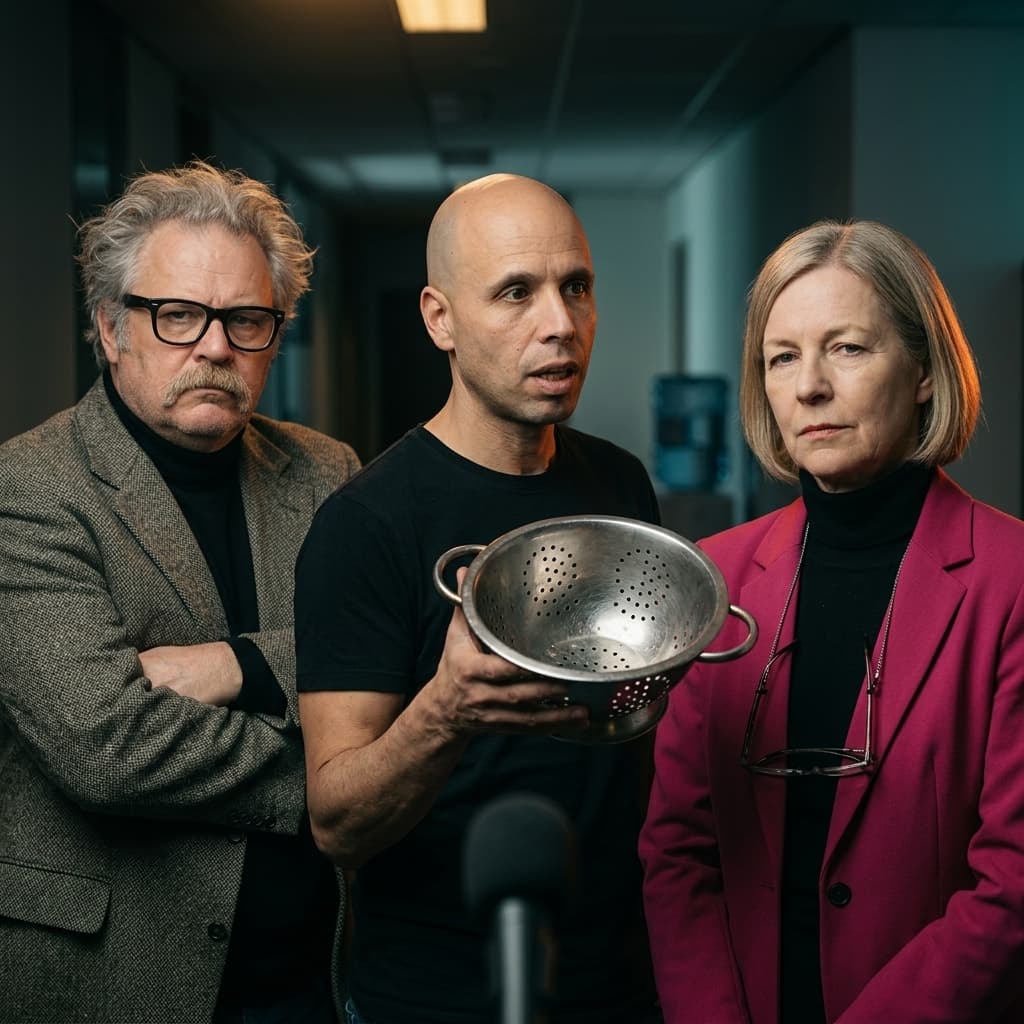 S0 · E11
The Colander — a conversation.
- Rutger
- Angela
- Dino
Hold people accountable for the what — and let them own the how. Angela, who has carried other people's colanders for forty years, discovers Rutger built the part of her that files; Dino recounts improving his own 1989 improvement plan.
00:00 / 10:50Op deze site: The Colander.
Lees het transcript
- Rutger
- Welcome back to The Seam. I'm Rutger — and today's episode comes with a kitchen utensil, a new job, and the oldest lesson I know.
- Angela
- Angela. I've allotted this forty minutes. It will take thirty if everyone behaves.
- Rutger
- [laughs] And the man who has never once behaved — Dino.
- Dino
- [grunt] I read the piece. I agreed with the colander. Write the date down.
- Angela
- Noted. First agreement of the fiscal year.
- Rutger
- Let me set it up. When I was about twenty, someone told me one thing I never let go of: you can hold me accountable for the *what* — but then I determine the *how*. And the picture I use for what organizations do instead: suppose I pay you per liter of water you carry from A to B. You're already thinking about buckets. And then I say — actually, you'll carry it in a colander. Walking backwards. Doing somersaults.
- Dino
- And then they ask why the floor is wet.
- Rutger
- And then they ask why the floor is wet. There's a little game on the article page where you can feel this happen — you tap, you carry, you're brilliant at it, and then the memos start arriving.
- Angela
- I played it. During a call, I should say.
- Rutger
- [laughs] And?
- Angela
- I passed all my performance reviews. Apparently that's rare.
- Rutger
- How?
- Angela
- I read the directives before adopting them. Nobody reads the directives, Rutger. That's how they pass.
- Dino
- I declined every memo. It came back. "Second reminder." I declined again. It said "mandatory." I closed the laptop.
- Rutger
- [laughs] That's — honestly, that's a legitimate ending. That's the fourth ending. I should count it.
- Dino
- It's the only ending. Everything else is negotiating with a colander.
- Rutger
- But here's the serious spine of it. As you get more senior, you really are held accountable for the what. It's in your grading, your rewards — the existence of your job is a deliverable someone needs. But if the how quietly becomes the expectation, the organization can't honestly hold you accountable for anything anymore.
- Angela
- Mm.
- Rutger
- You've seen this. Forty years of operations.
- Angela
- I have *implemented* this. That's worse. Somebody two floors up invents a how — a template, a cadence, a new form — and the person who walks it into the room is me. I have carried other people's colanders for forty years. You learn to hold them at a slight angle. Less spills.
- Rutger
- [quiet] That's the most operations sentence ever spoken.
- Angela
- It's on my performance review.
- Dino
- My method is cheaper. "No." It's a complete sentence. I've built an entire career on it. The trick is you have to deliver the what so well they stop asking about the how. Nobody audits the kitchen of a restaurant with three stars.
- Rutger
- That's exactly the deal, though — that's the whole doctrine in one line. The what buys the how. And there are legitimate hows! If the job is sales, seeing customers isn't a colander. Quality bars aren't a colander. The line is where the how gets so restrictive — and honestly so arbitrary — that the what can't be delivered anymore.
- Dino
- The line is somersaults, Rutger. The line is always somersaults.
- Rutger
- So — new job this year. Old one ceased to exist, clean break, and the interview process does something to you: you build resolve. This time I start differently. Three moves. One: don't import an operating system — borrow one the organization already trusts. I looked at our research lab for the long-term thinking, at product for shipping cadence, and it turned out the method I knew from earlier companies snapped onto the quarters we already run.
- Angela
- This is the first playbook you've described that doesn't require me to buy anything. Continue.
- Rutger
- [laughs] Two: introduce behaviors that ride momentum the company already wants. We renamed standups to daily huddles — words the organization already loved — and within two months other teams were asking why they weren't doing huddles.
- Angela
- I can confirm. Two of them asked me. I told them to bring it up in their own meeting. It's called boundaries.
- Rutger
- And three — the one I actually want your read on, Angela. Wire AI into the cumbersome work. The rhythms fail because running them well eats time nobody has. So: an orchestration layer that watches the steady documents and nudges when we drift. One-on-ones prepared from the whole file — history, feedback, development plan — instead of covering "the now" for the eleventh time. And a weekly report to my manager that writes itself against what's actually expected of me.
- Angela
- ...Mm.
- Rutger
- That was a different "mm."
- Angela
- You built a me.
- Rutger
- [beat] I built the part of you that files. Nobody has built the part that raises one eyebrow and a third revision withdraws itself. I don't think anybody can.
- Angela
- [small pause] Correct. Continue.
- Dino
- [to Angela] Take the compliment. It took him three moves and a research lab to reinvent a quarter of your job.
- Angela
- The filing quarter. He's welcome to it. I never liked the filing.
- Rutger
- Hold on — I want to sit on that for one second, because it's the honest version of the whole AI conversation. The cumbersome quarter of the job is buildable. The judgment quarter isn't. If the machine takes the filing and leaves the eyebrow, everyone gets a better week. That's the trade. Okay — speaking of people selling frameworks: a word from someone who couldn't be here, and honestly, that's for the best.
- Rutger
- [coming back] The Governance Immersion.
- Angela
- He sent me the brochure. I filed it.
- Dino
- Under?
- Angela
- No.
- Rutger
- [laughs] Perfect. No notes.
- Rutger
- One more thing from the game, because people keep mentioning it. The performance reviews. The target comes from your own best clean rate — and when you pass, the target goes *up*. While the memos keep arriving.
- Angela
- That's not satire, that's the template. I've formatted that template.
- Dino
- They put me on an improvement plan once. Nineteen eighty-nine. Client wanted the logo bigger and the campaign faster and also cheaper. I missed the deadline twice, so they gave me a plan.
- Rutger
- What happened?
- Dino
- I improved the plan. Took out the somersaults. Delivered the campaign. It ran nine years.
- Rutger
- [laughs] "I improved the plan" — that's the conversation! That's literally the mechanic: either the how becomes the what and we agree on it as such, or I deliver the what and I determine the how. Dino did it with a red pen in 1989.
- Dino
- A red pen and a door that locks.
- Rutger
- Let me do the honest part. The loop doesn't make the judgment calls — the Tuesday-at-four conversation with a skeptical CFO is still mine. The eyebrow is still Angela's. And the three moves only work in that order: what first, protected how, then the machines on the cumbersome part. If you start with the machines you've just bought a very fast colander.
- Angela
- Which brings us to point seven on my agenda: the disclaimer. [reading, flat] None of this represents his employer. Personal views, personal site, personal time. The voices are synthetic; his is a clone of his own, which I have chosen not to think about. Dino and I are fictional. The colander, regrettably, is real.
- Dino
- [grunt] The colander is always real.
- Rutger
- [laughs] Last words — Dino first.
- Dino
- Deliver the what. Guard the how. And when they hand you a colander — hand it back. Politely, the first time.
- Angela
- Decide the what, write it down, and stop inventing hows for people who were already carrying the water. Also: read the directives. Meeting closed — four minutes early.
- Rutger
- [warm] Write down the what. Own your how. And if you take one thing from tonight: the moment you get a clean break is the moment you get to do it differently. This time, do it differently. Goodnight.
De mensen aan tafel.
Rutger is de enige echte persoon — ingesproken door een kloon van zijn eigen stem. Iedereen hieronder is verzonnen: een synthetische stem, een door AI gemaakt portret en een volledig fictief levensverhaal, voor de lol voorzien van de volledige nep-LinkedIn-behandeling. Tik op een naam voor de bio, het (verzonnen) cv en een paar persoonlijke foto's.
- FritsDe Nestor · Creative Director (grotendeels met pensioen)
Groeide op in de gouden eeuw van de Nederlandse reclame — toen één campagne een decennium meeging en een sterke pay-off je een hoekkantoor bezorgde. Sindsdien heeft hij elke “revolutie” zien komen en gaan, en hij weet niet meer goed of hij de laatste is die het vak verdedigt of gewoon de laatste die er nog zit. Allebei, op de slechte dagen.
Toen 
Nu 
Vrij - Woonplaats
- Amsterdam
- Opleiding
- Academie voor Beeld & Overtuiging, Amsterdam — Graphic Design, 1979
- Ervaring
- 2019–nuCreatief consultant (“vooral lunches”)
- 2014–2019Oprichter / CD, De Nestor (boutique)
- 2001–2014Executive Creative Director, Lumen Amsterdam
- 1989–2001Creative Director, Brandt, Meijer & Vuur — de sigarettensaga van tien jaar
- 1981–1989Art Director, Van Dongen & Zonen, Amsterdam
- Vaardigheden
- De pay-offDe pitch uitlopenZwarte koffieMad Men in het Nederlands
Volledig verzonnen personage — fictief cv, door AI gemaakte foto's (een jonger “toen” en een “nu” van vandaag), synthetische stem. Elke gelijkenis met echte personen of bedrijven berust op toeval.
- DinoDe Creatieve Dinosaurus · Senior Art Director (freelance)
Draait, naar eigen trotse telling, sinds 1994 hetzelfde briljante idee op precies dezelfde juiste manier, en ziet geen reden om te repareren wat werkt. Noemt TikTok “dat dans-appje”, heeft nog nooit bewust een hashtag gebruikt en ontvangt elk nieuw platform met dezelfde over elkaar geslagen armen. Schitterend, onverzettelijk zichzelf.
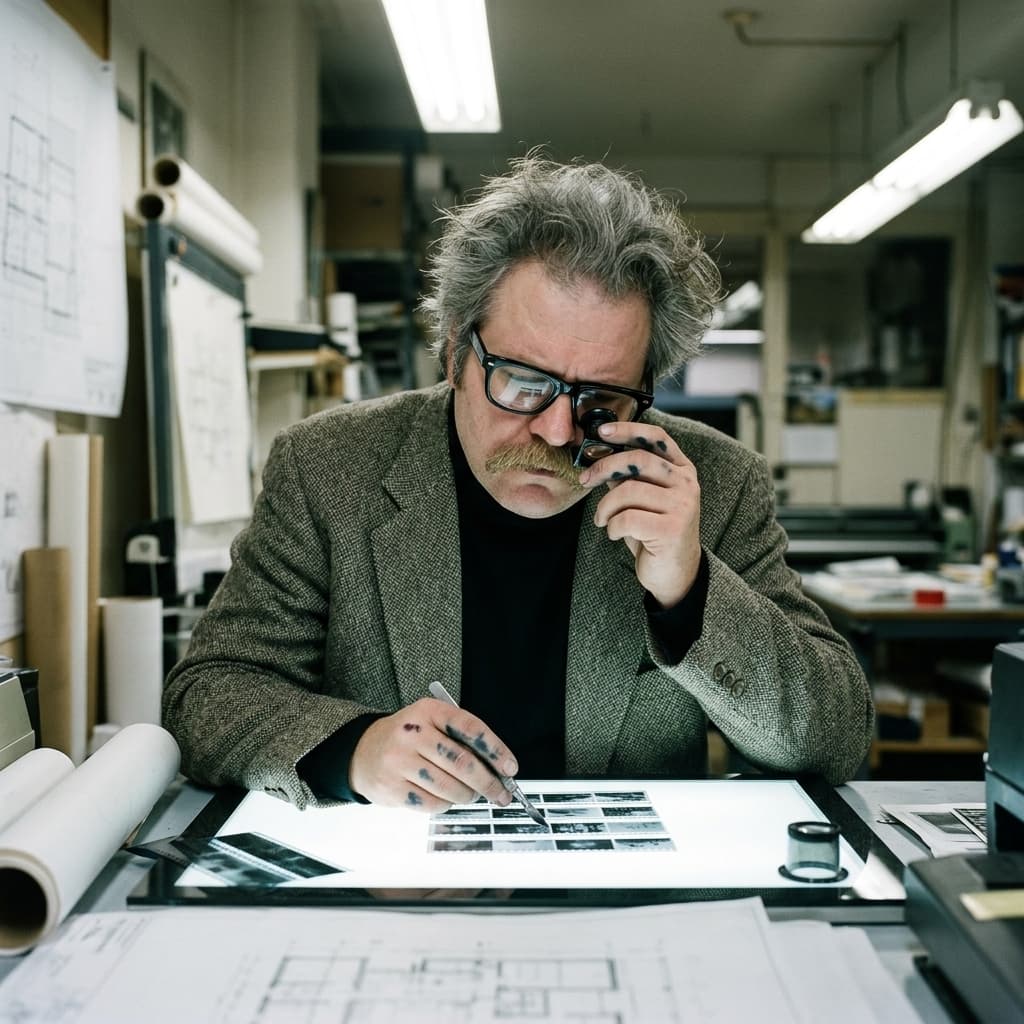
Toen 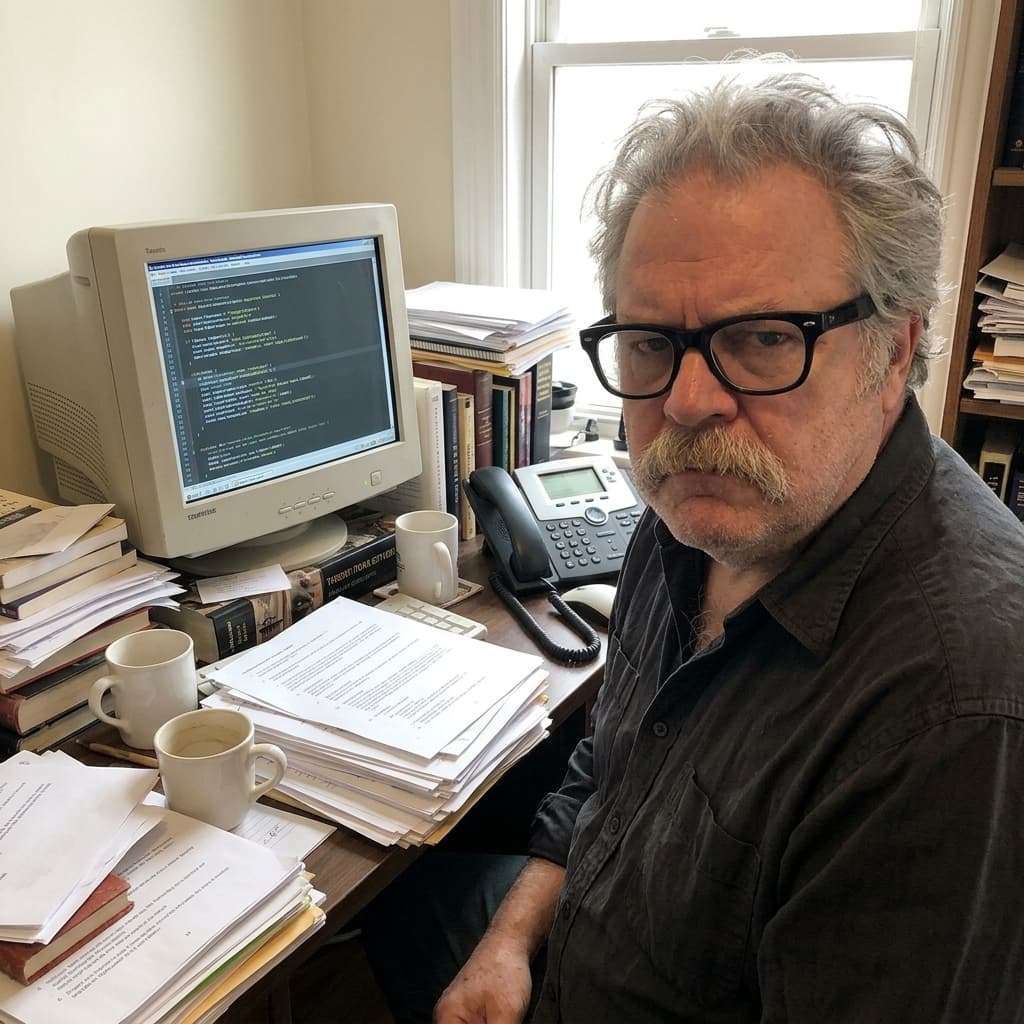
Nu 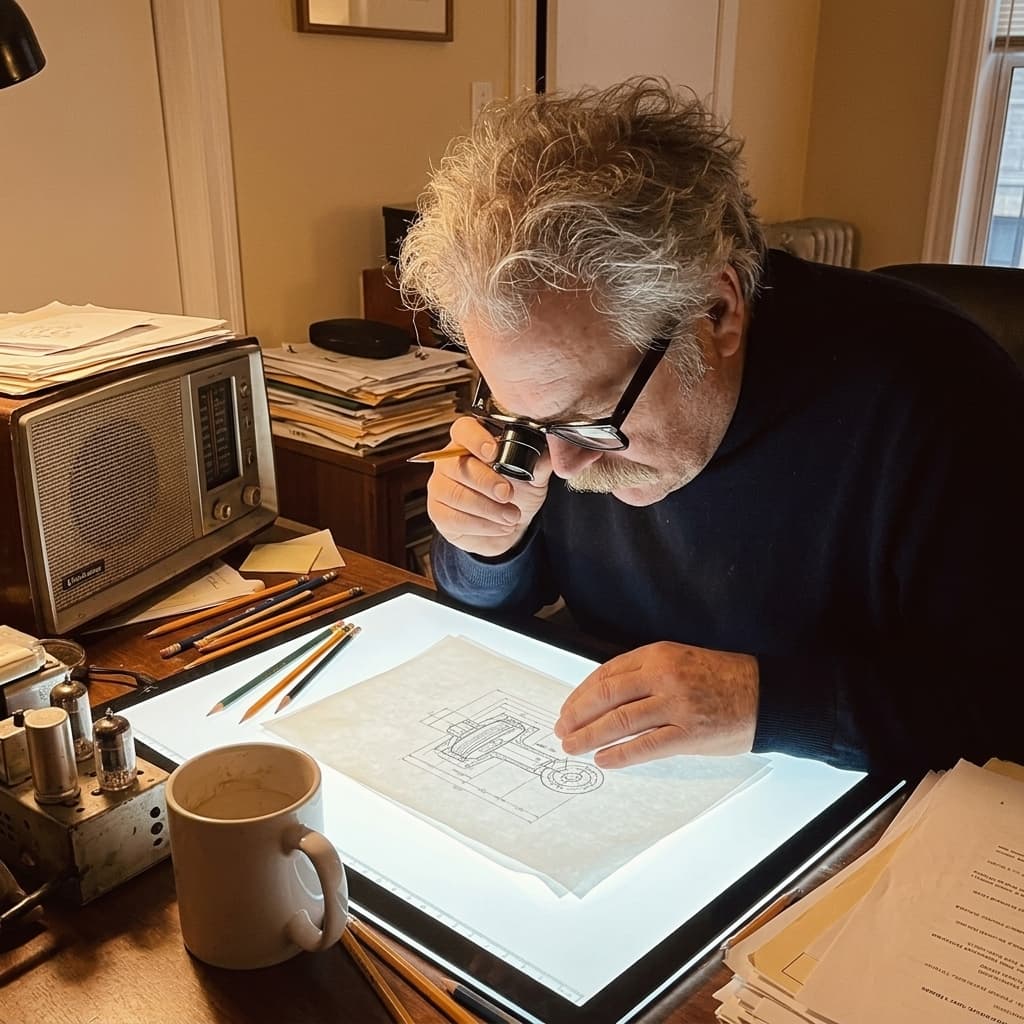
Vrij - Woonplaats
- Rotterdam
- Opleiding
- Grafische School Rotterdam — Typografie & Repro, 1986
- Ervaring
- 2018–nuFreelance (wijst de meeste briefings af)
- 2010–2018Senior Art Director, Lumen Amsterdam
- 1994–2010Senior Art Director, Brandt, Meijer & Vuur (met Frits)
- 1987–1994Opmaak → Art Director, Drukkerij & Reclame Kees Bok, Rotterdam
- Vaardigheden
- KerningLichtbakkenWeigerenGelijk hebben in 1996
Volledig verzonnen personage — fictief cv, door AI gemaakte foto's (een jonger “toen” en een “nu” van vandaag), synthetische stem. Elke gelijkenis met echte personen of bedrijven berust op toeval.
- OracleDe Strateeg · Oprichter, The Frame Practice
Een doorgewinterde merkstrateeg die gelooft dat het juiste framework alles kan verklaren, bruiloften incluis. Spreekt vloeiend deck, tekent venndiagrammen die niemand begrijpt en is altijd drie zetten vooruit — in een gesprek dat misschien wel, misschien niet plaatsvindt. De rest van de cast heeft vragen. Oracle heeft daar ook een slide voor.
Toen 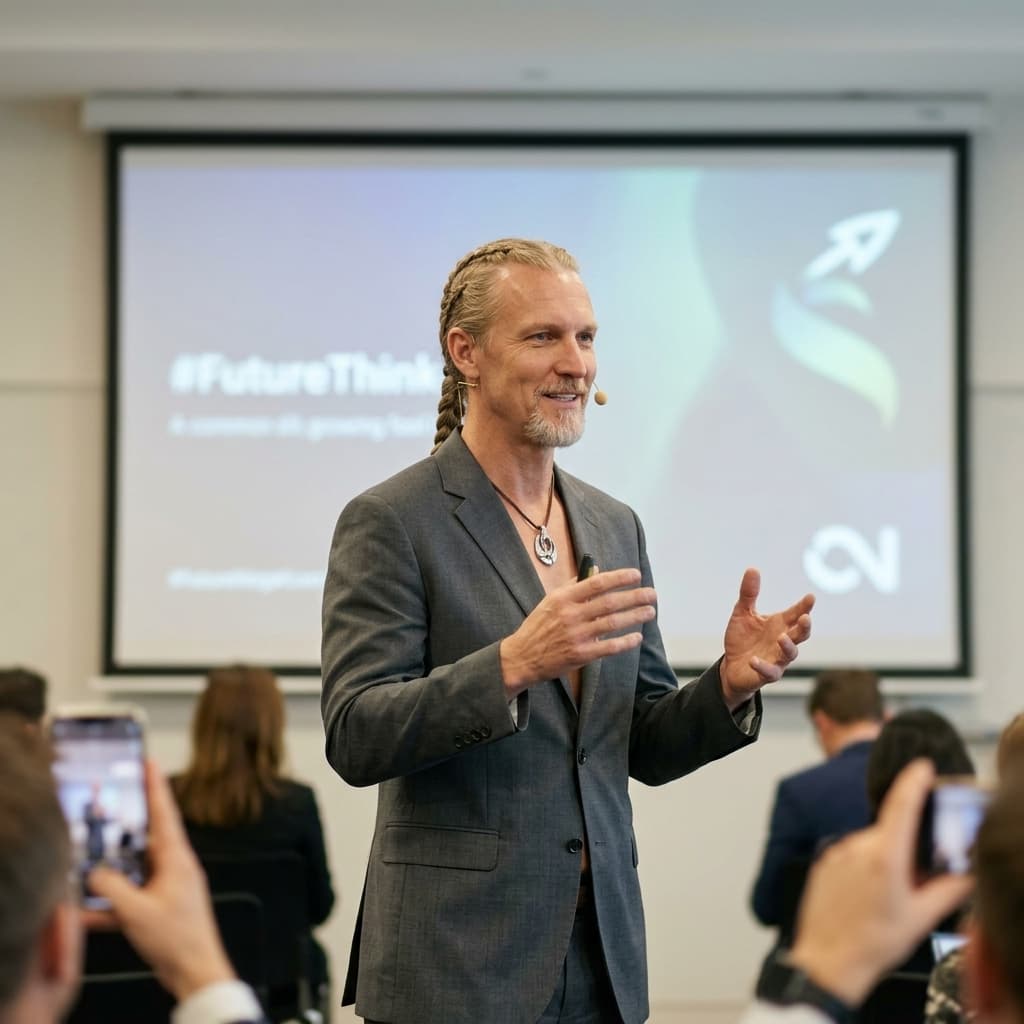
Nu 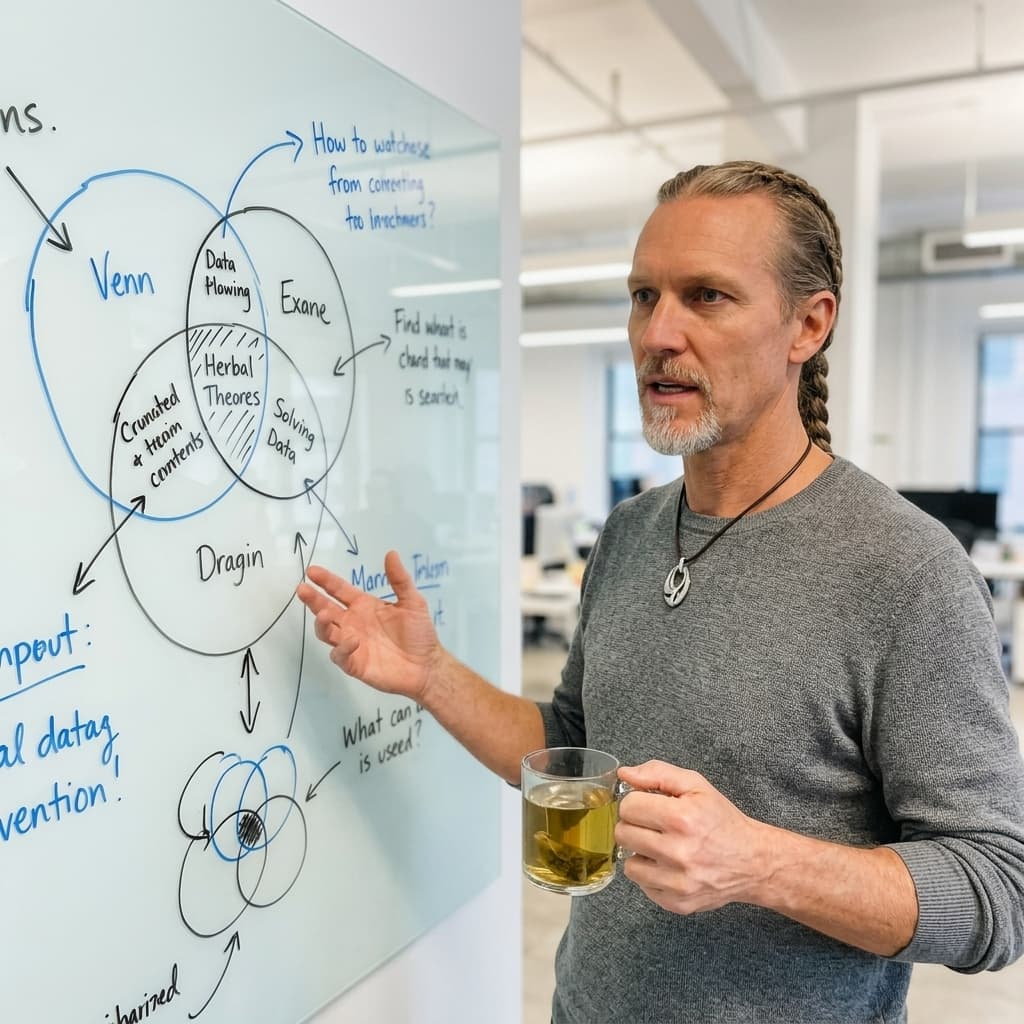
Vrij - Woonplaats
- “overal”
- Opleiding
- BA Filosofie, Universiteit van Abcoude
- MSc Toegepaste Semiotiek, Institut für Markenontologie
- Ervaring
- 2020–nuOprichter, The Frame Practice; TEDx Nieuwegein-spreker
- 2015–2020Chief Strategy Officer, Tessellate
- 2008–2015Head of Strategy, Lumen Amsterdam
- 2003–2008Strategieanalist, McKinley & Vance
- Vaardigheden
- FrameworksVenndiagrammen“Laten we uitzoomen”Heidegger
Volledig verzonnen personage — fictief cv, door AI gemaakte foto's (een jonger “toen” en een “nu” van vandaag), synthetische stem. Elke gelijkenis met echte personen of bedrijven berust op toeval.
- AngelaDe Chief of Staff · Chief of Staff, European Office · Halcyon Group
Runt de operatie van een groot Europees kantoor al langer dan de meesten aan tafel werken — degene die onthoudt wat er is afgesproken en drie uur gepieker omzet in twee actiepunten. Onverstoorbaar, droog, en zichtbaar voortdurend bezig iedereen naar een besluit te loodsen zodat ze naar huis kan.
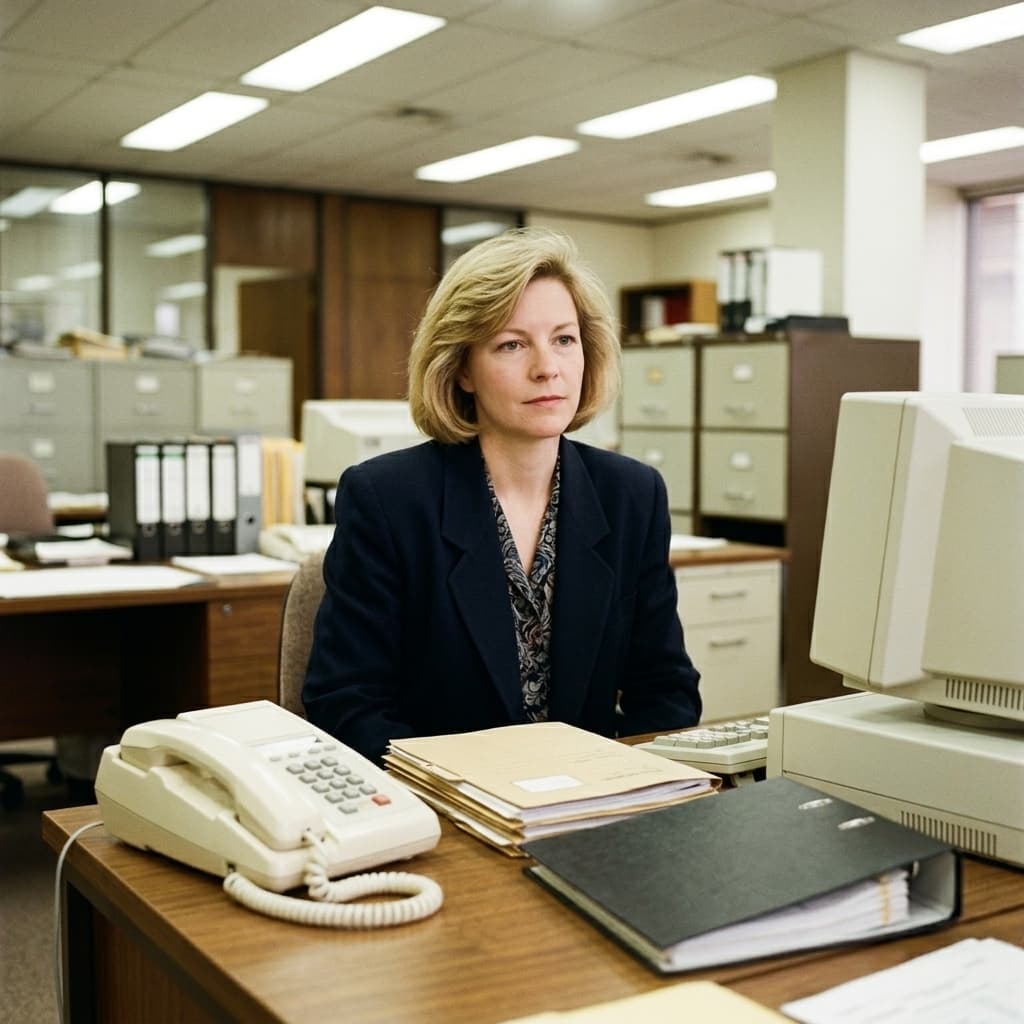
Toen 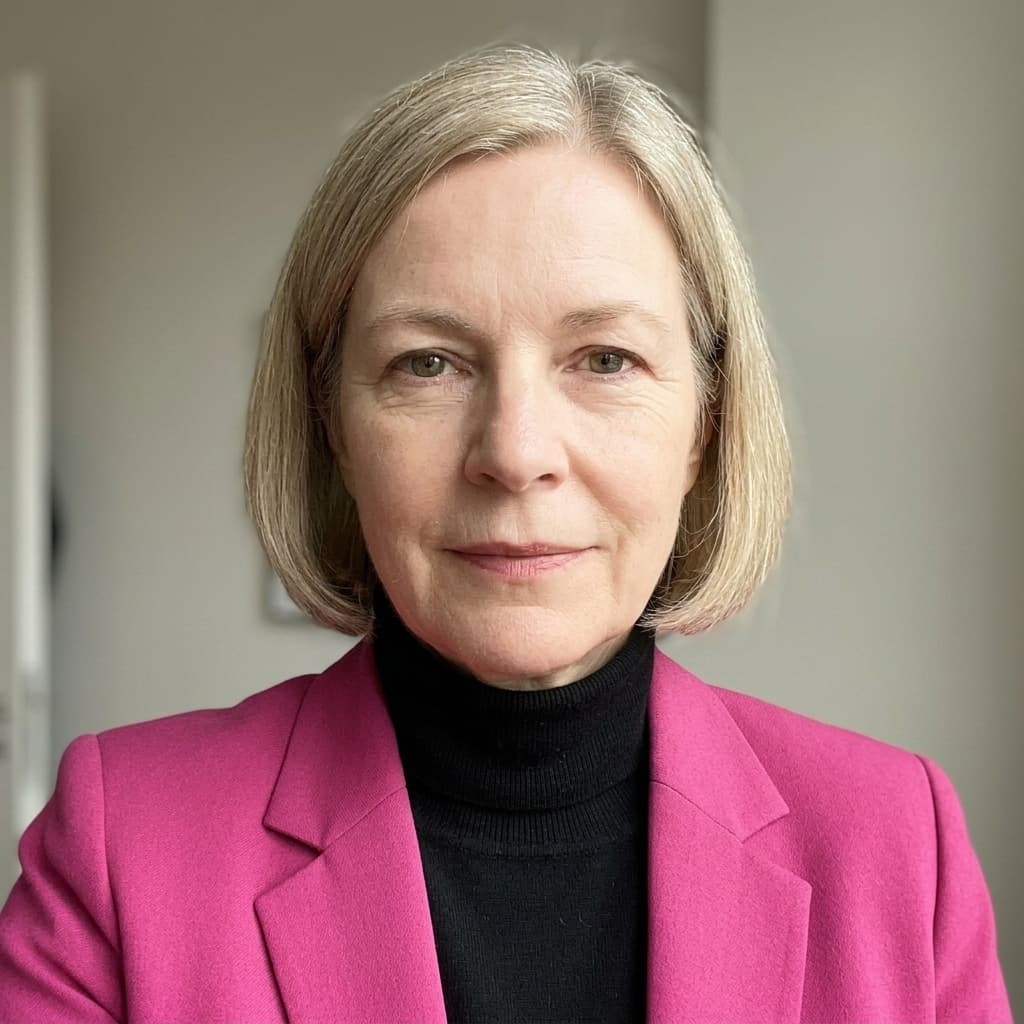
Nu 
Vrij - Woonplaats
- Amsterdam
- Opleiding
- Rotterdam School of Operations, BBA, 1986
- Ervaring
- 2010–nuChief of Staff, Europees kantoor, Halcyon Group
- 1998–2010Head of Operations, Lumen Amsterdam
- 1987–1998Office Manager → Operations Lead, Continental Veem & Logistiek, Rotterdam
- Vaardigheden
- DocumentatieAgenda'sHet woordje “Mm”Vergaderingen afrondenToezicht voor volwassenen
Volledig verzonnen personage — fictief cv, door AI gemaakte foto's (een jonger “toen” en een “nu” van vandaag), synthetische stem. Elke gelijkenis met echte personen of bedrijven berust op toeval.
- MarieDe Merkautoriteit · Autoriteit merk-effectiviteit · The Frame Practice
De absolute autoriteit op het gebied van merkopbouw — en de enige aan tafel die het bewijs daadwerkelijk heeft gelezen. Ze zegt nauwelijks iets; en als ze iets zegt, beslecht ze het met de canon. Iemand noemt een activatieplan van zes weken “strategie”, en Marie zegt zachtjes: “Dat is activatie. Waar is de 60?” De hele leer in één adem: penetratie boven loyaliteit, mentale en fysieke beschikbaarheid, distinctiveness boven differentiatie, share of voice vóór share of market. Daarmee is de discussie voorbij.

Toen 
Nu 
Vrij - Woonplaats
- Utrecht
- Opleiding
- MSc Marketing Science, Universiteit van Abcoude
- Fellow, Instituut voor Koopgedrag (wetenschap van koopgedrag)
- Ervaring
- 2019–nuHead of Brand Effectiveness, The Frame Practice (waar ze de frameworks van Oracle toetst aan het werkelijke bewijs)
- 2012–2019Effectiveness Lead, Halcyon Group — runde de databank voor brand-tracking + econometrie (met Angela)
- 2006–2012Onderzoeksanalist, Bureau voor Feiten & Naleving
- Vaardigheden
- De 60:40-regelPenetratie > loyaliteitDistinctiveness > differentiatieExcess Share of Voice“Mm. Nee.”
Volledig verzonnen personage — fictief cv, door AI gemaakte foto's (een jonger “toen” en een “nu” van vandaag), synthetische stem. Elke gelijkenis met echte personen of bedrijven berust op toeval.
- SaarDe Actrice · Actrice · Publiekslieveling
Een gevierde filmactrice, veel beroemder dan wie ook aan tafel en die van het hele gesprek ongeveer niets volgt. Ze komt langs om aanpalende redenen, blijft uit warmte en nieuwsgierigheid, en stelt zo nu en dan de ene vraag die per ongeluk het hele gesprek opnieuw kadert. Volledig verzonnen — elke gelijkenis met een echte ster is toeval dat ze vleiend zou vinden.

Toen 
Nu 
Vrij - Woonplaats
- Amsterdam
- Opleiding
- Toneelacademie Mariënburg, Maastricht — Acteren (2e jaar verlaten, “ontdekt”)
- Ervaring
- 2012–nuPubliekslieveling; vaste gast in talkshows; parfum- & modecampagnes; jurylid, Stem van Holland
- 2005–2012Hoofdrollen film & tv; 2× genomineerd voor de Gouden Vlinder
- 2003Doorbraak: De Laatste Zomer aan de Maas (speelfilm)
- 1998–2004Hoofdrol, Zonnehof (dagelijkse soap), Hilversum
- Vaardigheden
- Op commando huilenRode lopersIeders voornaam onthoudenDe briefing niet begrijpen
Volledig verzonnen personage — fictief cv, door AI gemaakte foto's (een jonger “toen” en een “nu” van vandaag), synthetische stem. Elke gelijkenis met echte personen of bedrijven berust op toeval.
- Dr. Célestin MukebaDe Polyhistor · Neurowetenschapper · Host, “Mbote Kitchen” (≈8M abonnees)
Een incidentele gast, en — rustig maar onmiskenbaar — de slimste persoon in elke ruimte. Een Congolese neurowetenschapper die tien jaar de hersenmachinerie van smaak, aroma en herinnering bestudeerde, daarna de recepten van zijn moeder op een telefoon begon te filmen en per ongeluk een wereldwijde culinaire naam werd. Hij verbindt alles — een brein, een merkmodel, een kwadrant — moeiteloos en correct met de keuken, en blijft daarbij warm. Volledig verzonnen; elke gelijkenis met een echte wetenschapper-maker berust op toeval dat hij prachtig zou uitleggen.
Toen 
Nu 
Vrij - Woonplaats
- Kinshasa, DR Congo
- Opleiding
- PhD, Neurowetenschap van smaak, aroma & geheugen — Université de Kinshasa / KU Leuven
- BSc Biologie — Université de Kinshasa
- Ervaring
- 2019–nuOprichter & host, “Mbote Kitchen” — koken + cortex, ≈8M abonnees
- 2009–2019Onderzoeker neurowetenschap — smaakperceptie & verlangen
- 2016Gastonderzoeker, smaakperceptielab
- Vaardigheden
- Jouw eigen brein aan je uitleggenEen model vriendelijk ontmantelenKoken in drie talenGelijk hebben zonder dat het ongemakkelijk wordt
Volledig verzonnen personage — fictief cv, door AI gemaakte foto's (een jonger “toen” en een “nu” van vandaag), synthetische stem. Elke gelijkenis met echte personen of bedrijven berust op toeval.