 Rutger
 Oracle
 Marie
Marie
00:00 / 10:30
Op deze site: Interactivity Is The New Explanation.
TRANSCRIPT
- Rutger
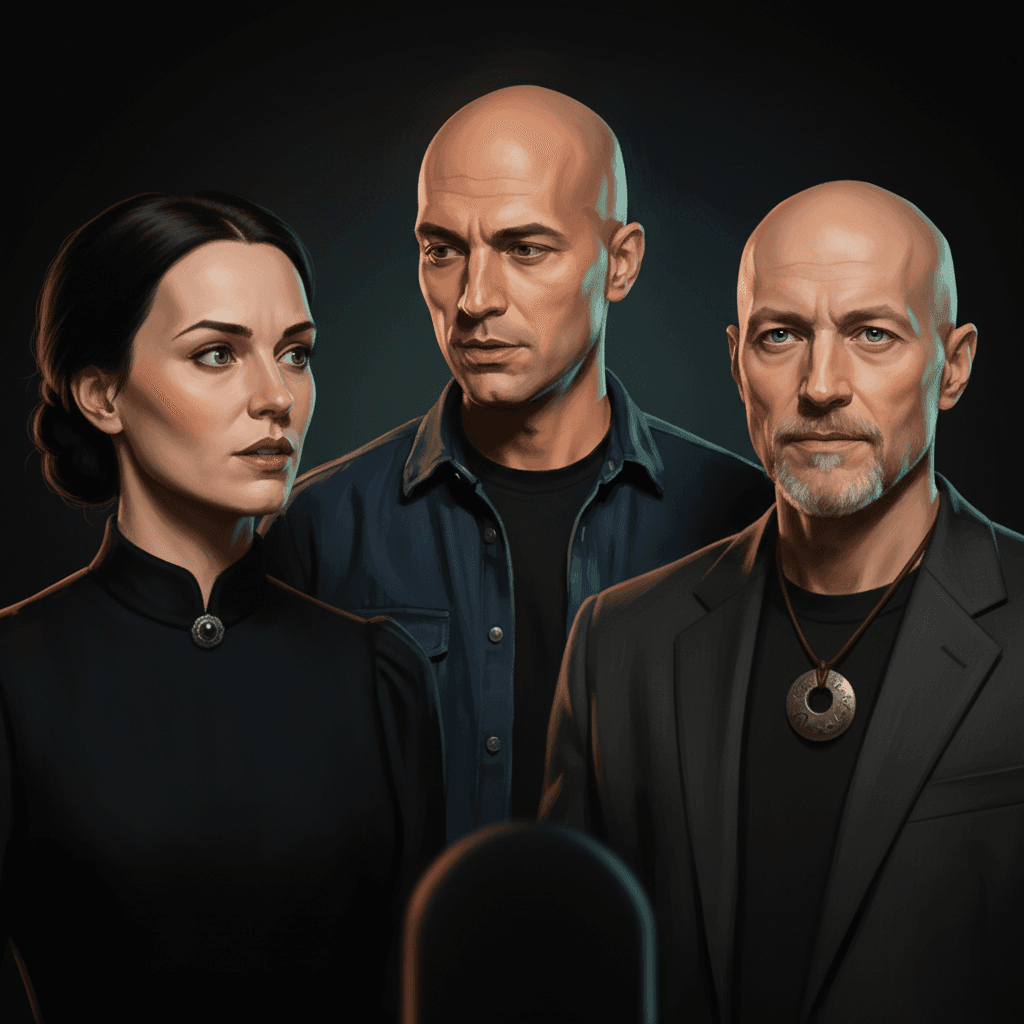
- Welcome in. I'm Rutger — coffee's bad, company's good, let's get into it. With me, Oracle — strategist, framework architect, owner of the only statement turtleneck in the building.
- Oracle
- A pleasure. I've prepared a deck nobody will see, which is when a deck is purest.
- Rutger
- And Marie — the one who reads the evidence so the rest of us don't get to make things up.
- Marie
- Mm. Someone has to.
- Rutger
- She'll speak four times all episode and win every exchange.
- Marie
- Three times. You're padding.
- Rutger
- [laughs] Noted. Okay — quick setup.
- Rutger
- For anyone who hasn't read the piece: the argument is that interactivity is becoming the new way to explain. When something's genuinely new — a tool, an AI workflow, an idea the room has no model for yet — a live, playable thing beats a static slide. You don't describe the loop; you hand someone the steering wheel for thirty seconds and watch their face change. The honest caveat the piece concedes is that a demo gives up the control of a frozen, signed-off argument — and that's exactly the hill Oracle wants to defend.
- Oracle
- I do not defend hills, Rutger. I defend *positions*. But yes.
- Marie
- And I've brought one question. With a follow-up.
- Oracle
- And I, naturally, have a deck. I've brought it in spirit, out of respect for your no-screens policy. The deck is present. The deck is simply choosing not to be seen.
- Rutger
- [chuckles] It's audio, Oracle. The deck was never going to be seen.
- Oracle
- And yet it shapes the room. That's the genius of the deck.
- Rutger
- Mm. Two little interactive demos sit right on the article as exhibits. You read it. Go.
- Oracle
- I read it twice. Once for pleasure, once for evidence. And my reaction, Rutger, is that you are writing for an audience that does not run a publicly listed company.
- Rutger
- Mm — say more.
- Oracle
- [a beat] Let's zoom out. A slide is not a picture. A slide is a *frozen argument*. It is signed off, dated, distributed, archived. When it is eventually wrong — and all slides are eventually wrong — you can reconstruct the exact meeting where the wrongness was approved. That is civilisation, Rutger. A live demo is a *performance*. Performances are magnificent. They are not minutes.
- Rutger
- — okay, that's actually a real distinction, and it's the one the piece concedes. Keep going.
- Oracle
- The frozen argument is the only honest one. Because it cannot be edited after it leaves your hand. The recipient reads the same nine words on slide seven that you wrote, in the order you wrote them, forever. That is control. That is rhetoric. A demo gives that up.
- Marie
- Mm. It can't be edited. It can be ignored.
- Oracle
- I beg your pardon?
- Marie
- A frozen argument nobody reads is still frozen. It just isn't an argument.
- Oracle
- [a beat] …That is a very European observation.
- Marie
- [dryly] I am very European.
- Rutger
- [laughs] Okay — right, let me defend Oracle for a second, because there's a true thing in there. A slide is portable. You can email a slide. You can drop it in a board pack and it travels to people who were never in the room. You cannot email a hover state.
- Oracle
- Thank you, Rutger. I was beginning to feel surrounded.
- Marie
- You were questioned. That is different from surrounded.
- Oracle
- In my experience the second is a subset of the first.
- Rutger
- Right — and here's where I push, though. The piece isn't arguing slides should die. It's narrower than that. It's that for a *new* concept — something the room has no model for yet — the deck loses them faster than the tool would. You can show a slide that says "agents collaborate." Nobody feels it. You hand them the little sim, they break it in ten seconds, and *now* they understand. Touch first. Write the slide together afterwards.
- Oracle
- [exhales] And this part I do not, in fact, disagree with. I simply think it is fragile in the wild.
- Rutger
- Fragile how?
- Oracle
- Ah — a demo only explains anything if it *works*. The wifi wobbles, the API rate-limits you at minute three, you fat-finger the prompt you rehearsed forty times — and now you are a man apologising to a board. A slide has no rate limit. A slide opens.
- Rutger
- [thoughtful] Yeah… yeah, that's a fair cost. The demo's failure mode is just — it's louder than the slide's.
- Marie
- One question.
- Rutger
- Mm — Marie.
- Marie
- When the demo fails on the wifi — what does the room conclude?
- Oracle
- That the technology is not ready.
- Marie
- Even though the failure was the wifi.
- Oracle
- [a soft laugh] *Especially* because the failure was the wifi. They do not separate the two. No one ever blames the router.
- Rutger
- That's bleak.
- Marie
- It's accurate.
- Oracle
- This is precisely why I keep my decks.
- Rutger
- And on that bleak little note — let me keep the lights on. One word from the people who pay for the wifi.
- Oracle
- I will say, that is a firm I respect. Largely because they employ Marie.
- Marie
- They audit Oracle. That's the job.
- Rutger
- [laughs] Welcome back. Okay — the thing I want to land is that the asymmetry has moved. A few years ago a live AI demo in a boardroom was a coin-flip that mostly came up tails. Now the model holds, the latency's fine, the thing just runs. The weak link is genuinely down to the wifi.
- Oracle
- [chuckles] A bold structural claim, resting entirely on the wifi.
- Rutger
- Exactly — I'll stand on the wifi.
- Oracle
- I will note that you are now defending infrastructure you do not control. That is also a kind of performance.
- Marie
- — He said "asymmetry has moved." He means it fails less. It still fails.
- Rutger
- [laughs] Granted. It fails less. It still fails.
- Marie
- Now the follow-up.
- Rutger
- Mm — go.
- Marie
- The piece says interactivity is the new explanation. What does it stop explaining?
- Rutger
- [exhales] …Yes. I mean — that's the question I circled the whole time and, honestly, never quite pinned in the article. There's a version where I —
- Oracle
- — I would like a moment, if I may, to enjoy watching Rutger be caught out by the precise woman.
- Rutger
- [laughs] Take the moment. Okay — I'll answer it honestly. [a beat] Every format… every format gives something up to get something. The deck gave up motion. The video gave up density — you can't skim a video. And the live demo, well — it gives up the frozen argument. That's Oracle's whole case, and it's right. A deck you can't edit once it's sent. Slide seven says what it says. A demo gets rewritten every single time you run it — sometimes sharper, often sloppier, never the same artefact twice.
- Oracle
- [warmly] At last. He arrives at the deck.
- Rutger
- [a soft laugh] The demo wins involvement. It loses control of the message. You point the room at the idea and let them touch it — but you've handed them the steering wheel, and they don't all drive the same way.
- Marie
- Mm. So it gains involvement and loses fidelity.
- Rutger
- …Yes. That's the sentence. That's the one the piece was missing.
- Oracle
- Marie. Have you considered working for my firm.
- Marie
- I work for your firm.
- Oracle
- [a beat] I am offering you a *better* role.
- Marie
- You don't know my current one. You've never read my contract.
- Oracle
- I do not read contracts. I read the *space around* the contract.
- Marie
- That's where the errors live.
- Rutger
- [laughs] Okay — landings. Oracle, the bumper sticker. When is the slide the right answer?
- Oracle
- [a beat] Ah. When the decision must outlive the meeting. When the audience cannot touch the thing in the moment. When the artefact will be forwarded twice and survive both forwards intact. Three conditions. I do not give them away cheaply.
- Rutger
- Hah — that's a good three, actually. Almost no quadrant in it.
- Oracle
- There is a quadrant. It is implied. I am sparing you.
- Rutger
- [chuckles] And Marie — same question, your version.
- Marie
- Demo when they need to feel it. Slide when they need to keep it.
- Rutger
- [a beat] …Yeah. That's tighter than either of ours.
- Oracle
- It is also unbillable. There is nothing to invoice in eleven words.
- Marie
- That sounds like your problem.
- Rutger
- [laughs] Right. So — here's where we actually land. [a beat] The slide and the demo, they're not rivals — they're a trade. The demo lets the room touch the idea and walk out involved. The slide freezes the argument so it survives the walk to the next meeting, where — well, where nobody from this room will be standing. You give up one to get the other. That's the whole piece, and Marie's right that I owed it a sentence.
- Oracle
- I will be billing you for these insights, Rutger. And I will be putting Marie's eleven words on a slide.
- Marie
- It loses something on a slide.
- Oracle
- [a beat] …What does it lose?
- Marie
- You.
- Rutger
- [laughs] Oh — on that, then. For the record, none of this is a Google position. It's my read, on my site, synthetic voices. Oracle's a character and an invoice. Marie is —
- Marie
- Correct.
- Rutger
- That's our button. Interactivity is the new explanation — point the room at the idea and let them touch it. Just keep one frozen slide for the people who weren't there. Goodnight.